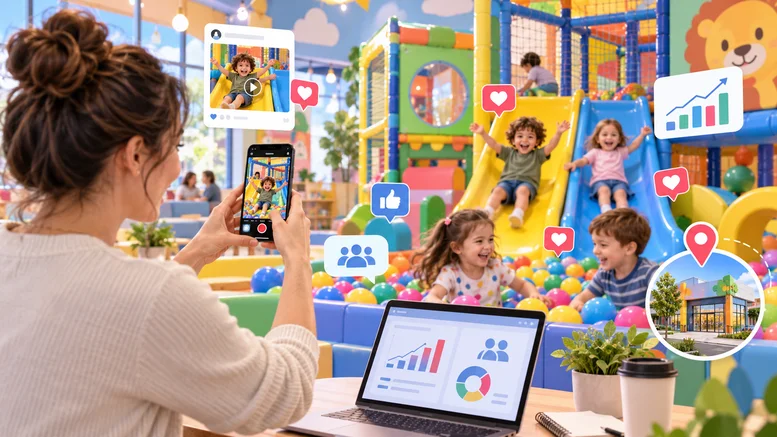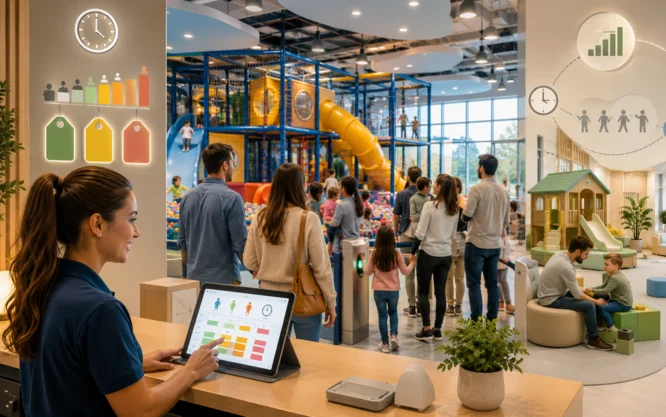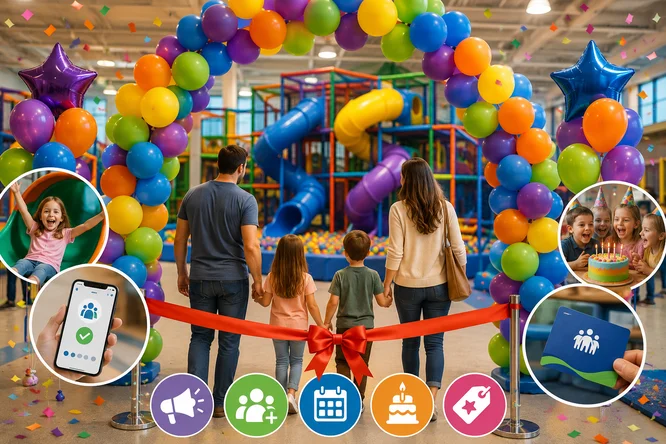
An Indoor Playground Grand Opening Marketing Playbook should turn local attention into pre-opening leads, opening-week visits, founding memberships, and birthday bookings. For the US market, build the campaign around a 10- to 12-week runway (following your initial location selection and facility size planning): collect parent contacts, test operations with a soft opening, launch with community partners, and follow up with every visitor afterward.
Start with launch goals and a clear offer
Your grand opening needs a commercial goal alongside the event goal. “Get people through the door” is too broad to guide a budget or show whether the launch worked.
Choose three to five measurable outcomes before you create the first ad:
- Waitlist contacts, split into email and SMS subscribers.
- Founding memberships sold before opening.
- Opening-week admission bookings.
- Birthday-party inquiries and deposits.
- Cost per lead, booking, and membership.
- Repeat visits within 30 days.
Define the offer behind each goal. A free ticket may create attention, while a founding membership or birthday consultation can create revenue. Use different landing-page buttons and tracking links so you know which offer produced each result.
Also calculate the basic economics of a visit as part of your overall startup and operating budget. Estimate the average admission value, expected food and retail spend, staffing cost, payment fees, and acquisition cost. This prevents you from celebrating a busy launch that loses money on every heavily discounted visit.
Use a 10- to 12-week opening timeline
The exact schedule depends on construction, permits, hiring, and the opening date. A 10- to 12-week marketing runway gives a new venue enough time to build recognition and test the customer journey.
| Timing | Main work | Required output |
|---|---|---|
| Weeks 12–9 | Define positioning, packages, audience, opening date, and measurement plan | Launch brief, offer rules, tracking spreadsheet |
| Weeks 8–6 | Publish the landing page, open the waitlist, start local lead ads, and contact partners | Lead capture system and first creative set |
| Weeks 5–3 | Announce founding memberships, publish construction and behind-the-scenes content, and secure local partners | Membership sales page, email/SMS sequence, event partners |
| Weeks 2–1 | Invite soft-opening guests, brief staff, distribute press information, and increase retargeting | Test schedule, press kit, final event plan |
| Opening week | Run the soft opening, fix operational issues, and host the grand opening | Launch report and customer feedback |
| Days 7–30 | Request reviews, follow up on party leads, promote memberships, and schedule a weekday partner event | Retention and follow-up campaigns |
Keep one source of truth for the date, hours, address, ticket rules, and package availability. A date or price mismatch between your website, Google Business Profile, social pages, and ads will create unnecessary calls and erode trust before opening.
Build a waitlist that parents have a reason to join
A waitlist works when it offers useful access, not when it asks for an email address with no explanation (a core pillar of how to attract parents to your indoor playground). Create a mobile-first landing page with one main action: “Join the opening list.”
Include:
- The neighborhood or city and an easy-to-find map reference.
- The expected opening window, labeled as an estimate if construction is still underway.
- The age ranges and play zones you plan to serve.
- A short explanation of admission, birthday parties, memberships, and café options.
- A specific opening benefit, such as priority booking or an early-bird pass.
- Separate, clear consent for email and text marketing.
- A link to the privacy policy and contest terms if you run a giveaway.
Useful lead magnets for a US family audience include a rainy-day activity guide, a birthday planning checklist, or a printable list of questions to ask an indoor play venue. Keep the download closely connected to the future purchase. A generic prize can produce a large list of people who have no interest in visiting.
Use a short welcome sequence rather than sending one announcement and going quiet:
- Send the promised guide or offer immediately.
- Introduce the venue’s age zones, party packages, and parent amenities.
- Share a construction update, team introduction, or short safety walkthrough.
- Offer founding membership or priority booking while the benefit is genuinely available.
- Send the opening date, booking instructions, parking information, and what families should bring.
- After the event, ask whether the visitor wants a birthday consultation, membership details, or a return-visit offer.
For SMS, collect explicit consent and state what messages subscribers will receive. Include opt-out instructions and keep time-sensitive messages useful. Check your provider’s terms and applicable US requirements before launching text campaigns.
Sell founding memberships with rules customers can understand
Founding memberships can create early cash flow and give the opening a built-in group of advocates (learn more in our complete guide to membership programs for indoor playgrounds). The offer should reward early commitment without creating confusion for your front desk later.
A practical founding offer can include:
- A limited number of memberships, with the limit displayed honestly.
- A defined introductory rate or locked benefit period.
- Clear access hours and blackout dates.
- The number of children and adults included.
- Guest-pass, birthday-party, café, and retail benefits.
- Cancellation, pause, renewal, and refund terms.
- A direct link to manage or cancel the subscription.
Consider different tiers only when the benefits are operationally distinct. For example, an off-peak membership can support weekday demand, a family tier can serve frequent visitors, and a premium tier can include earlier booking access. Avoid five tiers that all require staff to interpret different exceptions.
Use a visible counter only if the number is accurate. False scarcity may create a short-term lift, but it gives customers a reason to distrust future offers. Train staff to explain the membership in one sentence and to show the same terms that appear online.
Run a controlled soft opening before the public event
A soft opening gives the team time to test arrival, play, food service, cleaning, and payment processes under real conditions. A five- to seven-day testing window can work well when each session has a specific purpose and a controlled guest count.
| Suggested day | Guest group | Operational focus |
|---|---|---|
| Day 1 | Staff and vendor families | Emergency procedures, equipment checks, staff positions, and café setup |
| Day 2 | Founding members | Membership access, reservations, waivers, and benefit validation |
| Day 3 | Waitlist guests | Arrival flow, parking instructions, check-in, and customer questions |
| Day 4 | Schools, child-care providers, and PTO/PTA contacts | Group visits, supervision expectations, and educational partnerships |
| Day 5 | Local parenting creators and media | Photo permissions, content access, and event messaging |
| Day 6 | Limited public bookings | Full-service test of capacity, staffing, food, cleaning, and refunds |
Use a conservative capacity cap at the start and increase it only when the previous session is stable. A soft opening should expose bottlenecks while there is still time to fix them.
Test each part of the customer journey:
- Can a parent find the entrance, parking area, check-in desk, restrooms, and toddler zone?
- Can guests complete a digital waiver before arrival on a phone? (See our guide on indoor playground waiver setup and checklists).
- Can staff identify a membership, party booking, refund, or add-on quickly?
- Can the team see the main play areas from assigned positions?
- Does the café handle a sudden order peak without blocking check-in?
- Are incident, cleaning, lost-child, and emergency procedures documented?
- Can a manager close the register and reconcile online and in-person sales?
- Does the website show accurate remaining capacity in each bookable session?
Send a short survey after each visit. Ask what slowed the family down, which part of the venue was unclear, and whether the parent would return. Give managers a daily list of fixes with an owner and deadline.
Design the grand opening as a local event with a sales path
The grand opening should give families a reason to attend, a simple way to participate, and a clear next step after the event. A ribbon-cutting alone rarely fills a full day.
Build the program around one memorable moment, several short activities, and a practical offer:
| Example time | Program element | Marketing purpose |
|---|---|---|
| 9:00 a.m. | Media and community partner preview | Give local reporters and partners a quiet time for interviews and photos |
| 10:00 a.m. | Ribbon-cutting and welcome | Create a clear photo moment for local coverage and social sharing |
| 10:30 a.m.–noon | Explorer Passport across the play zones | Encourage families to discover the venue and interact with staff |
| Noon–2:00 p.m. | Local food samples or café demonstration | Introduce the parent offer and local suppliers |
| 2:00–3:30 p.m. | Charity raffle, activity, or school fundraiser | Connect the venue with a visible local cause |
| 3:30–5:00 p.m. | Birthday and membership consultations | Turn event interest into bookings and recurring visits |
Give children a safe activity connected to the theme: a stamp passport, building station, scavenger hunt, or supervised craft. Make the final stamp redeemable for a future-visit offer rather than an additional discount that applies only to the launch day.
Invite people who can extend local reach:
- City, chamber of commerce, or neighborhood representatives.
- School principals, PTO/PTA leaders, and child-care directors.
- Nearby cafés, family businesses, and food vendors.
- Local parenting newsletters and creators.
- A community organization that families already recognize.
If you run a fundraiser, document the beneficiary, collection method, dates, and amount or percentage being donated. Put those terms on the event page. Do not promise that all proceeds will be donated unless the offer actually supports that promise.
Plan the physical event as carefully as the promotion. Use timed entry if necessary, create a separate line for pre-registered guests, keep an accessible route clear, assign a staff member to parking and arrivals, and set a family photo-consent process. Review food service, raffles, music, alcohol, and temporary signage with the appropriate local authorities and vendors.
Own the local search result before opening day
Local discovery often starts with searches such as “indoor playground near me,” “kids birthday party in [city],” or “things to do with kids this weekend.” Your marketing should make the opening date and booking path easy to find from those searches.
Complete your Google Business Profile
Claim and verify the Google Business Profile as soon as the business is eligible. Keep the name, address, phone number, website, hours, opening date, and booking link accurate. Choose the most accurate primary category available and add relevant secondary categories only when they describe real services.
Upload a complete set of images: exterior approach, entrance, each play zone, party room, café, restrooms, seating, and parking. Google’s photo guidance lists file requirements and recommends photos that help customers understand the business before visiting.
Publish a dated event or offer post with the opening details and terms. Ask real customers for reviews after the soft opening and respond to every review with specific, human replies (see our playbook on Google reviews for indoor playgrounds). Never script a review that requires customers to use a keyword or claim an experience they did not have.
Create pages for high-intent searches
Your website should have separate pages for:
- Indoor playground admission in [city].
- Toddler or early-childhood play sessions.
- Kids’ birthday parties.
- Memberships.
- Group visits and school or PTO/PTA events.
- The grand opening event.
Answer questions in the first few lines of each page: age limits, socks, supervision, hours, admission, parking, food rules, party duration, and booking steps. Consider implementing dynamic pricing for indoor playgrounds to optimize weekday vs. weekend rate structures. Add event, local business, and FAQ structured data only when the page content matches the markup. The Party Center Software SEO and AEO guide offers additional FEC-specific ideas for organizing this content.
Use paid media to support intent
Start with channels that can be measured against a local booking or lead:
| Channel | Best use | Tracking method |
|---|---|---|
| Google Search | Capture active searches for admission and birthday parties | Separate campaign and landing page by intent |
| Meta ads | Show the space, people, and launch offer to nearby parents | Lead form or landing-page conversion event |
| Nextdoor | Reach nearby neighborhoods and support local recommendations | Neighborhood-specific code or landing page |
| Partner newsletters | Borrow trust from schools, PTO/PTAs, cafés, and family businesses | Unique link or redemption code |
| Organic social video | Build familiarity with staff, zones, parties, and opening progress | Saves, shares, profile visits, and assisted bookings |
Test a five- to 15-mile radius based on drive time and local density. A rural venue may need a wider area than a city venue. Use separate creative for toddlers, school-age children, birthday planners, and parents who need a weekday activity.
Every ad should answer four questions quickly: Where is the venue? When does it open? What does a visit include? What should the parent do now? Send the user to the matching page instead of a generic homepage.
Turn opening traffic into birthdays and weekday visits
Admission brings families in; birthday parties and repeat visits can increase the value of that relationship. (Check out market dynamics in our guides on Houston birthday party venues and Minneapolis birthday venues). Make the next purchase visible while the parent is already engaged.
Build three birthday packages
Three clear packages are usually easier to sell and operate than a long menu of custom combinations.
| Package | Suitable structure | Upsell options |
|---|---|---|
| Standard | Play admission, reserved party time, basic tableware, and a host checklist | Extra children, pizza, drinks, paper goods |
| Themed | Standard benefits plus themed décor and a party helper | Character visit, custom cake, upgraded décor |
| Private or VIP | Extended time, dedicated coordinator, or exclusive venue access | Premium food, photography, custom entertainment |
Show the guest limit, included adults, party duration, deposit, rescheduling rules, food policy, and cleanup responsibility before checkout. Let parents select a date and request a consultation without calling the venue. The booking page should make the highest-value add-ons easy to understand without forcing them into the base package.
Follow up with every opening-day family who asked about a party. A simple message can include the package comparison, available dates, and a link to schedule a call. Track inquiries separately from completed bookings so you can see where the sales process needs work.
Fill slow weekdays with School Spirit Nights
School Spirit Nights can bring a partner school or PTO/PTA into the venue during a slower weekday period. The school promotes the date through its own channels, and the venue gives the organization an agreed share or fixed donation tied to tracked sales.
Put the arrangement in writing. Confirm the event date, ticket offer, tracking code, reporting method, payment recipient, payout timing, promotion responsibilities, cancellation rules, and any restrictions on collecting parent data. A venue should not add families to a marketing list simply because they bought a school fundraiser ticket.
The PTO Today Spirit Night resources can help a new operator structure the partner conversation. Give each school a unique booking code so the result is visible in the POS report.
Other weekday programs can include toddler mornings, homeschool sessions, caregiver meetups, sensory-friendly hours, profitable summer camps, and local employer family nights. Choose programs that fit your staffing and safety model instead of filling the calendar with events that require a different operating setup every week.
Make safety and cleaning visible without overpromising
Parents want evidence that the venue is maintained. A sign saying “we care about cleanliness” is weaker than a dated checklist, trained staff, and a clear process for spills, illness reports, damaged equipment, and lost items.
Align your facility protocols with our indoor playground safety checklist and cleaning checklist to create a documented schedule with four layers:
- During each shift: Check high-touch surfaces, floors, restrooms, seating, and visible equipment damage.
- At close: Clean play surfaces, party rooms, café areas, mats, and other areas specified by the manufacturer.
- On a recurring deep-clean schedule: Inspect nets, seams, under-equipment areas, HVAC filters, and hard-to-reach surfaces.
- After an incident: Isolate the affected area, record the response, clean it using the approved product and contact time, and reopen only after inspection.
Set the exact frequency according to traffic, manufacturer instructions, facility design, local requirements, and advice from your insurer or qualified safety professionals. Keep chemical products and procedures in a staff-only operations manual. Publish the customer-facing version: what gets checked, when the last routine cleaning occurred, and how parents can report a concern.
Review the CPSC Public Playground Safety Handbook with your safety professional. The handbook explains that state and local jurisdictions, insurers, and applicable voluntary standards may set different expectations. It also distinguishes public playground equipment from indoor soft-contained play equipment, so an operator should confirm which rules and standards apply to the specific facility.
Use safety content in marketing carefully. Show staff inspections, clean zones, visible sightlines, and parent amenities. Avoid absolute phrases such as “germ-free,” “injury-proof,” or “100% safe.” Those promises are difficult to substantiate and can create avoidable legal and reputational risk.
Use a budget model that protects the first months
Marketing cannot compensate for a weak opening budget. Before announcing the event, reserve money for launch promotion, creative production, event costs, software, insurance, and working capital.
As an illustrative planning model, an operator might begin with these broad project shares and revise them after receiving local quotes:
| Budget area | Illustrative share | What to protect |
|---|---|---|
| Play equipment and installation | 50% | Safety, durability, maintenance access (see our guide on evaluating indoor playground equipment suppliers) |
| Build-out and design | 20% | Parent sightlines, traffic flow, acoustics |
| Working capital | 15% | Rent, payroll, utilities, and slower seasonal weeks |
| Pre-opening marketing | 7% | Lead generation, creative, launch event, local partnerships |
| Software and systems | 4% | Booking, POS, waivers, membership, reporting (see FEC technology trends) |
| Insurance, licenses, and professional services | 4% | Local compliance and risk review |
These percentages are a starting worksheet, not a forecast. Replace them with quotes for your city, lease, square footage, equipment, staffing plan, and permit process. Keep enough cash for the first three to six months of operations, especially if membership sales and repeat traffic are still developing.
Track the launch weekly:
- Cost per waitlist lead.
- Waitlist-to-booking conversion.
- Founding membership conversion and cancellation rate.
- Cost per birthday inquiry and booking rate.
- Event attendance and no-show rate.
- Average revenue per visit, including café and retail.
- Labor hours per occupied session.
- Refunds, incidents, and customer complaints.
- Review volume, rating trend, and response time.
- Repeat-visit rate within 30 days.
Pause ads that generate cheap leads with no bookings. Increase spend only when the landing page, offer, staffing, and capacity can handle the added demand.
Avoid the launch mistakes that create expensive cleanup
Announcing before the booking path works
Do not send local traffic to a page that says “coming soon” without collecting the visitor’s contact information. Test the form, confirmation email, payment flow, waiver link, and calendar on a phone before increasing spend.
Making the event bigger than the customer experience
A crowded opening can produce photos and complaints at the same time. Use timed entry, a capacity cap, and a separate line for pre-registered guests.
Using one discount for every audience
Toddlers, birthday planners, founding members, and school partners have different reasons to visit. Give each segment a relevant message and track the response.
Relying on a giveaway for the entire list
Use the giveaway to support a broader offer. Ask entrants whether they want opening updates, birthday information, or membership news, then send relevant follow-up with the consent they provided.
Ignoring the post-launch sales window
The first 30 days are when visitors still remember the experience. Ask for a review, make the next visit easy to book, and follow up on birthday questions while the venue is familiar.
Treating partnerships as free advertising
Schools, PTO/PTAs, local creators, and neighborhood groups need a clear benefit and a simple process. Provide ready-to-post copy, a unique code, a contact person, and a short report after the event.
A 30-day grand opening checklist
Use this list during the final month:
- Confirm the opening date, hours, capacity, age zones, admission rules, and parking instructions.
- Test the website on mobile from ad click to payment confirmation.
- Verify the Google Business Profile and upload exterior, interior, play-zone, party-room, and café photos.
- Publish the grand opening page with date, time, location, program, terms, and booking link.
- Create separate tracking links or codes for Google Search, Meta, Nextdoor, partners, and email.
- Confirm the soft-opening guest list and capacity for every session.
- Train staff on check-in, waivers, memberships, refunds, incidents, cleaning, and parent questions.
- Prepare a local press note with the story, event details, spokesperson, and approved images.
- Brief partners with ready-made emails, social posts, flyers, and redemption instructions.
- Stock party, café, retail, cleaning, first-aid, and signage supplies.
- Set the review-request and birthday follow-up automations.
- Review event logistics with the venue’s insurer, local authorities, and qualified professionals where required.
FAQ
How early should an indoor playground announce its grand opening?
Start collecting local leads about 10 to 12 weeks before the expected opening when possible. Announce the date only when construction, staffing, inspections, and the booking system can support it.
What should an indoor playground offer before opening?
Offer priority booking, a genuine founding membership benefit, or a limited opening-week pass. Match the offer to your goal and state the expiration date, access rules, and redemption process clearly.
Which marketing channels work best for a US indoor playground opening?
Use Google Business Profile and Google Search for active local intent, Meta for visual reach and retargeting, and neighborhood or school partnerships for borrowed trust. Test the mix against bookings and memberships rather than impressions alone.
Is a soft opening necessary?
A soft opening is strongly recommended because it lets staff test capacity, check-in, waivers, food service, cleaning, and emergency procedures before a full public event. Invite controlled groups and fix problems between sessions.
How can a new indoor playground get birthday bookings after the grand opening?
Show three easy-to-compare packages, publish guest limits and policies, allow date requests online, and follow up with visitors who asked about parties. Give staff a short consultation script and a target response time.
How can an indoor playground fill slow weekdays?
Start with School Spirit Nights, toddler sessions, homeschool hours, caregiver events, and employer family nights. Use unique codes and written partner terms so each program can be measured and reconciled.
Build momentum after the ribbon-cutting
The opening event creates attention; the follow-up system determines whether that attention becomes a durable customer base (see broader shifts in US indoor playground trends). Keep the Google profile current, publish real photos, respond to reviews, promote the next bookable date, and use the first month to refine staffing and offers.
Ready to fill your opening calendar? Publish a mobile landing page, connect it to booking and waiver tools, launch a permission-based waitlist, and give local families one clear reason to visit on opening week.