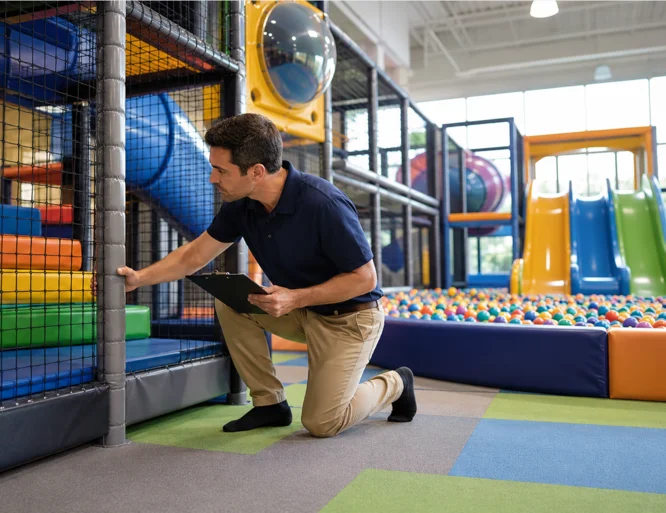
Indoor Playground Safety Inspection Checklist
An Indoor Playground Safety Inspection Checklist helps operators catch hazards before families arrive: loose padding, damaged netting, blocked exits, worn surfacing, dirty ball pits, sharp hardware, poor visibility, and missing inspection records. In the United States, the practical goal is simple: inspect the play area often, document what you found, fix defects quickly, and confirm local requirements with your city, state, fire marshal, insurer, and a qualified playground safety professional.
Who should use this indoor playground safety checklist?
This checklist is for indoor playground owners, family entertainment centers, soft play operators, trampoline or play cafes with toddler zones, daycare facilities with indoor play rooms, and managers preparing for a city, fire, licensing, or insurance inspection.
Use it as an operating checklist, not as a substitute for local code review. U.S. indoor playground rules vary by state and facility type. A play cafe, licensed child care center, mall attraction, amusement device, and private party venue may face different requirements even when the equipment looks similar.
For a commercial indoor playground, your inspection program should usually cover:
- Manufacturer installation documents
- ASTM F1918 or other applicable play equipment standards
- CPSC public playground guidance where relevant
- ADA play area accessibility requirements
- Local building, fire, electrical, and health rules
- State amusement ride or child care licensing rules where applicable
- Insurance carrier requirements
- Written maintenance and incident logs (increasingly automated via predictive maintenance and digital checklists, as discussed in FEC technology trends)
The quick daily safety inspection before opening
A daily inspection should take place before the first child enters the play area. The manager on duty should walk the full route a child can access, including crawl tunnels, raised decks, slides, toddler zones, party rooms, ball pits, and emergency exits.
| Area | What to check | Pass condition | Action if failed |
|---|---|---|---|
| Entrance gate | Gate, latch, wristband or check-in control | Gate closes, latch works, no uncontrolled entry | Stop admissions until repaired or staffed |
| Floor and surfacing | Mats, seams, rubber, carpet transitions | No lifted edges, gaps, holes, wet spots, or trip hazards | Block the area and repair or replace |
| Padding | Foam on posts, platforms, corners, barriers | Padding is secure and covers hard contact points | Reattach, replace, or close the component |
| Netting | Side nets, no-climb mesh, tunnel nets | No holes, sagging, broken ties, or climbable gaps | Close the level or route until fixed |
| Slides | Slide bed, exit zone, side panels, bolts | Smooth surface, clear exit, no exposed fasteners | Close slide and repair |
| Ball pit | Balls, pit liner, hidden objects | No broken balls, food, fluids, toys, or sharp items | Remove hazards, clean, disinfect if needed |
| Hardware | Bolts, clamps, hooks, zip ties | No protruding bolts, sharp ends, open hooks, or loose parts | Tighten, trim flush, cap, or replace |
| Visibility | Sight lines from staff stations | Staff can see high-risk areas and entrances | Adjust staffing or close blind areas |
| Exits | Exit doors, aisles, emergency paths | Doors open, aisles clear, signs visible | Clear immediately before opening |
| Cleaning | Touch points, restrooms, tables, party rooms | Clean, dry, stocked, and ready | Clean before guest arrival |
Train staff to write down failures, not just fix them. A short note such as “9:10 a.m. - loose foam at north tunnel post, area closed, repaired by maintenance at 9:35 a.m.” is much better than a blank checklist with every box marked “OK.”
Weekly technical inspection checklist
A weekly inspection should go deeper than the opening walk-through. Use basic tools: flashlight, work gloves, socket set, manufacturer torque guidance if provided, camera, ladder, inspection mirror, and the previous week’s repair log.
Check these items every week:
- Run a gloved hand along padded posts and zip ties to feel for sharp plastic cuts.
- Pull gently on netting, lacing, and mesh panels to find loose connections.
- Check that foam padding has not rotated away from the impact side of a post.
- Inspect slide joints from inside the slide path, especially tube slide seams.
- Look under platforms for loose brackets, cracked boards, missing fasteners, and exposed edges.
- Test movable play items, hanging bags, steps, ramps, and bridges under adult weight.
- Inspect toddler-zone barriers to make sure older children cannot easily enter during peak times.
- Confirm that any age, height, sock, capacity, and supervision signs are clean and visible.
- Review incident reports for repeated injuries in the same area.
- Verify that closed components are physically blocked, not just marked with a sign.
The best weekly check is partly mechanical and partly operational. A component can look safe when empty and still create risk during a birthday rush if children collide at the slide exit or staff cannot see inside a tunnel.
Monthly and quarterly inspection checklist
Monthly and quarterly checks should focus on structural condition, records, and higher-risk systems that are easy to miss during daily operations.
| Frequency | Inspection item | Practical test |
|---|---|---|
| Monthly | Anchors and base plates | Check for movement, corrosion, cracked concrete, and missing covers |
| Monthly | Raised platforms | Look for soft spots, flexing, loose deck panels, and damaged seams |
| Monthly | Entrapment risks | Review openings in rails, nets, ladders, and transitions for head or limb traps |
| Monthly | Electrical safety | Confirm cords, outlets, lights, and equipment are protected from children |
| Monthly | Emergency lighting | Test lights and exit signs according to your fire safety plan |
| Monthly | Fire access | Confirm sprinkler coverage has not been blocked by decorations, storage, or new equipment |
| Quarterly | Surfacing performance | Review wear patterns and schedule professional impact testing if required or recommended |
| Quarterly | Staff training | Refresh supervision zones, incident response, cleaning steps, and closure authority |
| Quarterly | Document binder | Update certificates, inspection reports, repairs, cleaning logs, and incident forms |
| Quarterly | Vendor repairs | Confirm manufacturer-approved parts were used for structural repairs |
If your state requires a specific inspection form or retention period, follow that rule. For example, some child care licensing programs require documented playground inspections and may specify who can perform them.
What standards matter for indoor playground inspections in the USA?
Indoor playgrounds often fall into a mixed regulatory area. One city may treat a soft contained play structure as a building feature, another may involve a fire marshal, and another state may regulate certain soft play units through amusement ride rules.
The main references operators should know are:
- CPSC Public Playground Safety Checklist, which highlights surfacing, spacing, entrapment, hardware, guardrails, maintenance, and supervision.
- ASTM F1918, the standard safety performance specification for soft contained play equipment. Confirm the current edition through ASTM or your qualified inspector.
- ADA play area guidance from the U.S. Access Board, especially accessible routes, play components, surfacing, and soft contained play structures.
- EPA-registered disinfectant guidance, which explains why the product label, registration number, use site, and contact time matter.
- Michigan’s playground inspection guidance, a useful example of how state licensing rules can require documentation and approved inspectors.
Do not assume that a manufacturer’s “ASTM compliant” statement covers your whole site (see our detailed guide on verifying safety documents and evaluating indoor playground equipment suppliers). Inspect the installed equipment, the building around it, the surfacing, fire access, cleaning process, staff supervision, and records.
The highest-risk hazards to inspect first
Most indoor playground hazards are ordinary defects that become serious because children move fast, climb unpredictably, and use equipment in groups. Start with the hazards that can cause severe injury or make emergency response harder.
1. Surfacing that no longer protects children
Soft flooring wears out in predictable places: slide exits, climber landings, ball pit entries, toddler gates, and high-traffic corners. Look for compressed foam, split seams, missing tiles, hard spots, and mats that slide underfoot.
Use a simple rule: if a child can fall, jump, tumble, or exit a slide there, the surface deserves a closer look. When in doubt, close the component until the surfacing is repaired or tested by a qualified professional.
2. Entrapment openings
Openings between rails, steps, ladders, net transitions, and platforms can trap a child’s head, neck, torso, hand, or foot. The CPSC checklist flags openings that can trap children and gives a practical screening range: spaces should generally be less than 3.5 inches or more than 9 inches where entrapment criteria apply.
Do not rely on eyesight alone. If a gap appears in a transition area, take a photo, measure it, and ask a CPSI or qualified inspector to evaluate the condition against the correct standard.
3. Sharp hardware and bad zip-tie cuts
Indoor soft play structures often use many plastic ties, clamps, bolts, brackets, and caps. A diagonal zip-tie cut can leave a hard plastic edge sharp enough to scratch skin. Protruding bolts, missing caps, cracked acrylic, and damaged slide seams can create the same problem.
Weekly glove checks work well here. If the glove snags, a child’s hand or cheek can snag too.
4. Poor slide exit design
Slide exits need clear, padded space. Do not allow toys, loose foam blocks, chairs, strollers, storage bins, or ball pit overflow at the runout area. Staff should be able to see whether children are sitting, standing, or wrestling at the exit before another child comes down.
Be especially careful with slides that end near ball pits. A child hidden under balls can be struck by another child exiting at speed.
5. Blocked exits and weak emergency access
Indoor play structures can become hard to navigate during a power outage, medical emergency, or fire alarm. Inspectors and staff should know how an adult can reach a child inside the structure and how children can leave without crossing blocked areas.
Check exit paths every day, then test emergency lighting and signs on a schedule. Decorations, party supplies, storage boxes, and stroller parking should never narrow an exit path.
Ball pit safety inspection checklist
Ball pits need their own checklist because hidden objects, broken balls, moisture, and bodily-fluid incidents are easy to miss.
Inspect the ball pit before opening:
- Drag your hands through the pit to the bottom and corners.
- Remove food, hair clips, small toys, coins, bandages, broken balls, and trash.
- Check that the liner is not torn, wet, moldy, or separating from the wall.
- Confirm children can enter and exit without climbing over an unstable edge.
- Keep slide exits separate from areas where children can be hidden under balls.
Set a clear closure rule for contamination. If vomit, blood, urine, feces, or other bodily fluid enters the pit, close the pit immediately, remove the balls, clean visible soil first, disinfect according to the product label, allow the required contact time, dry all surfaces, and document the incident.
EPA guidance is useful because disinfectants must be used according to their labels. Staff should know the product’s approved use site, dilution if any, contact time, safety precautions, and whether rinsing is required before children return.
Fire, building, and electrical checks
Fire and building inspections are local, so the exact requirements depend on your jurisdiction. Still, every operator should build these checks into the routine.
Check the following:
- Emergency exits are unlocked during operating hours where required and never blocked.
- Exit signs and emergency lighting work.
- Sprinkler heads are not blocked by platforms, signs, balloons, decorations, storage, or netting.
- Extension cords are not used as permanent wiring.
- Cords, outlets, fans, inflatables, vending machines, and arcade devices are protected from children.
- Storage is kept out of play zones, exit corridors, mechanical rooms, and electrical panels.
- Staff know who calls 911, who clears the play structure, and who meets emergency responders.
Keep fire marshal reports, alarm tests, sprinkler inspections, and electrical repairs in the same safety file as playground inspections. During an audit, scattered records slow everything down.
ADA and accessibility inspection points
The ADA applies to many newly constructed and altered play areas at places of public accommodation and state or local government facilities. For indoor playground operators, accessibility should be part of the inspection routine, not a one-time design issue.
Check that:
- Accessible routes to the play area are open and not blocked by tables, strollers, signs, or party supplies.
- Accessible entries into soft contained play areas remain usable.
- Transfer points, ramps, or accessible play components are not used for storage.
- Floor surfaces on accessible routes are stable, firm, and slip resistant.
- Staff understand how to support guests with mobility, sensory, hearing, or communication needs without making assumptions.
Also review static electricity risk around plastic slides and synthetic materials. Some families with cochlear implants may need extra precautions, such as removing external processors before play on high-static components. Post policies carefully and train staff to respond respectfully when parents ask about implant safety.
Staff supervision checklist
Equipment inspections reduce physical hazards, but active supervision prevents many common incidents (see our complete guide on how to hire and train staff for an indoor playground for onboarding and zone coverage). Staff should not be stationed where they can only watch the front desk.
Use supervision zones:
- One staff member watches slide exits and high-speed areas.
- One staff member watches toddler access during busy periods.
- One staff member handles check-in and capacity control.
- Party hosts monitor party-room transitions so children do not run unsupervised between rooms.
- Managers walk the full play floor during peak periods instead of staying in the office.
Give staff authority to close a component immediately. A loose net, wet floor, broken ball pit liner, blocked exit, or exposed bolt should not wait for owner approval.
Inspection record template
Keep records short enough that staff will actually complete them. A useful inspection entry should answer five questions: who checked, when they checked, what they found, what action they took, and when the area reopened.
Use this format:
| Field | Entry |
|---|---|
| Date and time | |
| Inspector name | |
| Area inspected | |
| Condition found | Pass / fail / monitor |
| Photo taken | Yes / no |
| Corrective action | |
| Area closed? | Yes / no |
| Reopened by | |
| Reopen time | |
| Manager review |
For serious defects, keep the record even after the repair is complete. Attach photos, invoices, manufacturer instructions, and inspector notes. A clean repair history helps you spot repeat failures and shows that the business takes safety seriously.
When should you hire a professional inspector?
Hire a qualified playground safety inspector before opening a new indoor playground, after major equipment changes, after relocation, after structural repair, after a serious incident, and on a recurring schedule set by your local rules, insurer, or risk policy.
Look for a professional who understands soft contained play equipment, not only outdoor playgrounds. Ask about CPSI certification, experience with indoor structures, insurance, independence from the manufacturer, and whether the final report includes photos, defect severity, corrective actions, and reinspection notes.
Some states or programs may require specific inspectors. Michigan, for example, describes a process for child care centers where inspections, when used to document compliance, must be completed by an approved Certified Playground Safety Inspector. Your state may handle the same issue differently.
Common inspection mistakes
Avoid these mistakes because they create real risk and weak documentation:
- Marking every checklist item “pass” without walking inside the structure.
- Inspecting only visible guest areas and skipping tunnels, upper levels, and under-platform spaces.
- Treating cleaning logs as safety inspections.
- Leaving damaged areas open because the defect looks small.
- Forgetting to reinspect after a vendor repair.
- Using disinfectants without checking the EPA registration number and contact time.
- Allowing decorations, storage, or party supplies to creep into exit paths.
- Keeping inspection forms that do not identify who performed the check.
- Depending only on the original installation certificate after years of wear.
The best inspection program is boring in a good way: consistent checks, fast closures, clear repairs, and records that match what actually happened.
FAQ
How often should an indoor playground be inspected?
An indoor playground should be inspected daily before opening, checked more deeply every week, reviewed monthly or quarterly for structural and documentation issues, and inspected by a qualified professional on a schedule based on local rules, equipment type, usage, and insurer requirements.
Is ASTM F1918 legally required for indoor playgrounds?
ASTM F1918 may be required when a state, city, contract, insurer, or licensing program adopts it or references it. Even when a standard is not directly written into law, operators should treat ASTM guidance as part of a serious safety and risk-management program.
Do indoor playgrounds need ADA access?
Many newly built or altered commercial play areas must comply with ADA accessibility requirements. Operators should review accessible routes, entries, transfer systems, surfacing, and play components with a qualified accessibility professional.
What should staff do if they find a hazard during play hours?
Staff should close the affected area immediately, move children away, notify a manager, document the hazard, take photos if helpful, and reopen the area only after the defect is corrected and reviewed.
Should ball pits be cleaned every day?
Ball pits should be inspected every day and cleaned on a written schedule based on usage, manufacturer guidance, and health expectations. Any bodily-fluid incident should trigger immediate closure, cleaning, disinfection, drying, and documentation.
Final checklist for operators
Before you rely on your inspection program, confirm these basics:
- Daily opening checklist is completed before children enter.
- Weekly technical checklist includes netting, padding, hardware, slides, platforms, and ball pits.
- Monthly or quarterly review includes anchors, surfacing, emergency access, records, and staff training.
- Staff can close unsafe equipment without waiting for owner approval.
- Cleaning products are EPA-registered and used according to label directions.
- ADA routes and accessible play entries are kept clear.
- Local building, fire, licensing, and amusement rules have been checked.
- A qualified inspector reviews the structure at opening, after major changes, after serious incidents, and on a recurring schedule.
- Inspection records include dates, names, defects, corrective actions, photos when needed, and reopen times.
Use the checklist as a living document. Update it after incidents, repairs, equipment changes, staff feedback, and local inspection findings. That is how an indoor playground safety inspection checklist becomes part of daily operations instead of a folder that only comes out during an audit.