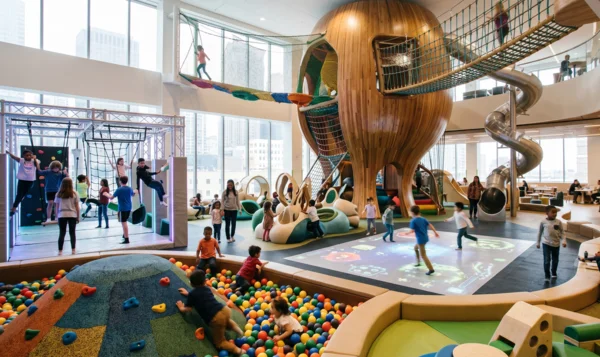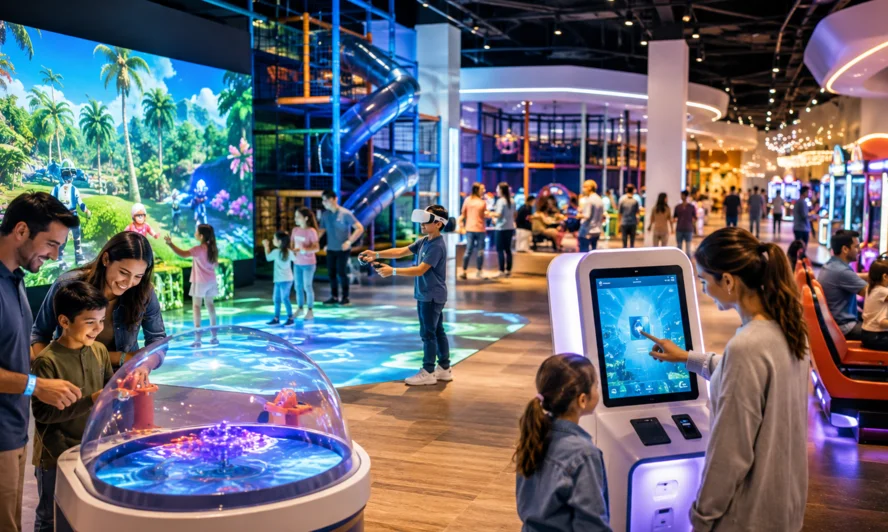
Family entertainment center technology trends in 2026 are moving toward connected, low-friction venues: cashless payments and mobile wallets, online booking with digital waivers, wearable-free mixed reality, AI-assisted operations, and privacy-by-design. For US operators, the goal is practical—shorter queues, better use of floor space, easier party management, safer maintenance, and clearer data controls.
Why technology matters more in US FECs
The strongest FEC technology projects solve an operating problem and improve the guest experience at the same time. A mobile wallet can reduce a reload line and give the operator better spending data. A digital waiver can speed up check-in and reduce manual paperwork. A mixed-reality attraction can create a new reason to visit while fitting into a relatively compact footprint.
This is also how the industry is discussing the next phase of FEC growth. The IAAPA 2026 FEC Summit agenda includes a dedicated session on social, demographic, and technological trends, followed by an experience lab focused on integrating trends and technology. That combination is a useful operating principle: technology should be tied to guest flow, revenue, staffing, safety, or repeat visits.
1. Cashless play is becoming a venue-wide system
Cashless technology is moving beyond arcade card readers. Modern systems can connect RFID game cards or wristbands with games, attractions, kiosks, food and beverage, party bookings, prize redemption, and mobile wallets. Guests can reload from a phone or tap at an attraction, while staff can see balances, play activity, and transaction history in one system. Embed describes this connected model for FECs and arcades.
For operators, the business value comes from the operating layer behind the payment. A connected system can help you:
- reduce coin, token, and ticket-handling tasks;
- shorten lines at the front desk and reload kiosks;
- connect game play with food, parties, and loyalty offers;
- monitor prize inventory and redemption activity;
- compare attraction usage by day, hour, age group, or event type.
The main implementation risk is treating cashless hardware as a stand-alone purchase. Before choosing a provider, confirm that the platform can integrate with your point-of-sale system, party calendar, online checkout, accounting exports, loyalty program, and guest support process.
Plan for exceptions as well. Parents may need a balance correction, a refund, a lost wristband, or help when a phone battery is dead. Keep a staffed service option and define who can adjust stored value. A venue that removes the cash desk without replacing its support process can create a new source of frustration.
2. Online booking, digital waivers, and capacity-based pricing are converging
Parents increasingly expect to complete the whole visit online: choose a birthday package, select a time, add extra children or food, pay a deposit, sign a waiver, and receive reminders. The same flow can support open-play tickets, memberships, camps, corporate events, and lane or simulator reservations.
FEC software platforms now package party bookings, ticketing, payments, waivers, memberships, reminders, and time-based pricing into one operating view. Sports Carnival’s FEC software overview shows the direction of the category, including real-time availability and pricing that can vary by day or time.
Dynamic pricing can help fill slower periods and protect high-demand capacity, but the rules must be easy to understand. A simple structure works better than a maze of discounts:
| Use case | Practical technology choice | Metric to watch |
|---|---|---|
| Busy Saturday parties | Fixed package capacity and deposit rules | Party utilization and no-shows |
| Slow weekday afternoons | Lower off-peak admission or an add-on bundle | Visits per available hour |
| High-demand attractions | Time slots with clear capacity limits | Queue time and completion rate |
| Repeat local guests | Memberships, passes, and automated reminders | Visit frequency and renewal rate |
Track the complete booking funnel, not only revenue. Useful measures include booking conversion, abandonment at waiver or payment, time from arrival to check-in, add-on attachment, cancellation rate, and the percentage of party guests who buy another attraction.
3. Wearable-free mixed reality is changing the VR decision
Wearable-free mixed reality is becoming a serious option for FECs that want immersive play without the friction of shared headsets, controllers, and long onboarding sessions. These attractions use projection, cameras, body tracking, and software to turn movement in a physical space into game input.
Valo Motion’s FEC solutions include mixed-reality products designed for group play, such as ValoArena, ValoJump, ValoClimb, and Groundfall. The company positions these attractions as visible, automated experiences that can support birthday parties and competitive group events.
The format fits FEC operations for several reasons:
- Players can understand the activity by watching other groups.
- Several people can play together instead of taking turns in individual pods.
- The attraction can appeal to children, teenagers, parents, and grandparents.
- The venue can use short sessions to manage demand and throughput.
- A branded video or score can give guests a reason to share the visit.
Wearable-free does not mean supervision-free. Operators still need a documented opening inspection, clear age and height rules, emergency procedures, cleaning routines, and staff who can manage queues and accessibility requests.
When comparing mixed-reality products, ask for more than a demonstration. Request the average session length, reset time, recommended staffing model, daily cleaning process, software update policy, player capacity, accessibility options, warranty terms, and integration options for booking and cashless payments. Also watch a full session from the spectator area. If guests cannot see what is happening, the attraction may lose part of its marketing value.
4. AI is moving into maintenance, staffing, and yield decisions
The most useful AI applications in an FEC are often invisible to guests. They help operators spot equipment problems, forecast demand, organize work orders, and identify underused capacity.
Predictive maintenance is a good example. Instead of waiting for an arcade reader, go-kart, HVAC unit, refrigeration system, or attraction component to fail, sensors can track operating signals such as temperature, vibration, cycle counts, and error logs. A maintenance platform can then turn an anomaly into an inspection or work order.
IAAPA’s coverage of amusement ride condition monitoring describes the shift from reactive maintenance to preventive and predictive approaches. The practical lesson for an FEC is to start with assets where downtime affects safety, peak capacity, or food service.
A useful first pilot looks like this:
- List the five assets that create the most downtime or emergency callouts.
- Record failure type, duration, time of day, labor used, and lost capacity.
- Add sensors or digital inspection forms only where the data can change a decision.
- Set alert thresholds with the maintenance team instead of accepting default settings.
- Review alerts weekly and measure avoided downtime, false alarms, and completed work orders.
The same data layer can support staffing and yield management. If the system knows bookings, occupancy, attraction availability, party schedules, and historical demand, managers can schedule staff around real workload instead of relying on a fixed weekly pattern. That does not remove human judgment; it gives managers better information before a busy Saturday begins.
5. Active play is becoming a gamified digital experience
Projection mapping, motion tracking, interactive floors, RFID profiles, digital leaderboards, and real-time scoring are turning physical attractions into repeatable games. A climbing wall can add timed targets. A trampoline area can score jumps. An obstacle course can save personal bests or run team challenges. Bowling, mini golf, and go-karts can use the same basic loop of skill, feedback, and replay.
This technology works when the physical activity remains easy to understand. Guests should know what to do within a few seconds, see progress while they play, and receive a result they can share or improve on a later visit.
Design the experience around several play modes:
- Cooperative: families work toward a shared score.
- Competitive: players race against each other or a leaderboard.
- Solo: a guest can practice without feeling excluded.
- Casual: younger children or first-time players can participate without a long tutorial.
Do not require a persistent account for every interaction. An anonymous session or temporary player ID can provide game feedback while reducing the amount of personal data the venue stores. If guests choose to save scores or receive videos, explain what information is collected and for how long.
6. Privacy-by-design is becoming part of attraction design
Connected attractions can collect names, email addresses, payment details, waiver information, photos, videos, movement data, player profiles, and device identifiers. In a venue serving children, those data flows need to be designed before the hardware is installed.
The FTC’s updated COPPA rule is especially relevant to FECs with connected websites, apps, booking tools, or online game features. The amended rule became effective June 23, 2025, and most covered entities had until April 22, 2026 to comply with the amendments. The changes include biometric identifiers in the definition of personal information, separate parental consent for certain third-party disclosures, and limits on retaining information longer than reasonably necessary. See the FTC’s final COPPA rule summary and the Federal Register compliance dates.
California adds another layer. The California Privacy Protection Agency says regulations covering risk assessments, cybersecurity audits, and automated decision-making technology took effect January 1, 2026 for certain businesses. Requirements depend on the business, data, and activity, so a national FEC should review its exposure instead of assuming one privacy notice covers every state. The CPPA’s 2026 update page provides the current rulemaking status.
Use this checklist before launching a connected attraction:
- Map every data field collected at booking, check-in, play, payment, and prize redemption.
- Separate information needed to operate the attraction from optional marketing data.
- Use a clear parent-facing notice at the point of collection.
- Build separate consent controls for child data, advertising, third-party sharing, and saved profiles where required.
- Set deletion rules for raw photos, videos, motion data, and inactive accounts.
- Review every vendor’s security terms, data processing role, retention period, and breach process.
- Provide a practical way to play or complete a booking when a guest declines optional marketing data.
The key distinction is between a system that tracks a game session and a system that identifies a person. Do not assume that calling data “game analytics” removes privacy obligations. Ask counsel to review any facial recognition, voice capture, persistent movement profile, age verification, or child-directed online feature before launch.
7. Integrated venue platforms will outperform disconnected tools
The common thread across these trends is system integration. A cashless wallet creates useful data only when it connects to the attraction schedule, party booking, POS, loyalty, and reporting systems. Predictive maintenance works better when managers can see the impact of downtime on bookings and capacity. Privacy controls need to follow a guest record across the same systems.
When evaluating a new platform, ask these questions:
- Can the system share data through documented APIs or reliable exports?
- Who owns the guest, transaction, and gameplay data?
- Can staff see attraction status, bookings, payments, waivers, and open tasks in one workflow?
- Can the venue restrict access by role and location?
- Can the operator delete or export records without a manual vendor request?
- What happens when the internet connection, payment terminal, or central server is unavailable?
- Can the platform support multiple locations without forcing every venue into the same pricing and operating rules?
An integrated architecture does not require one vendor for every function. It does require clear ownership of the data model, reliable connections between systems, and a documented fallback for outages.
How to prioritize FEC technology upgrades in 2026
Start with the bottleneck that costs the venue the most money or guest goodwill. Use a simple score from one to five for each proposed project:
| Decision factor | Question |
|---|---|
| Guest friction | Does the upgrade remove a queue, repeated form, or confusing handoff? |
| Revenue capacity | Can it sell more available time, add-ons, parties, or repeat visits? |
| Labor impact | Does it reduce repetitive work while keeping staff available for guests? |
| Safety and compliance | Does it improve inspections, access control, privacy, or incident records? |
| Integration | Can the system work with the tools you already use? |
| Payback visibility | Can you measure the result within one operating season? |
For many small and mid-size FECs, a sensible sequence is:
- Clean up online booking, waivers, party packages, and capacity rules.
- Connect payments and cashless play across the highest-volume attractions.
- Add a digital maintenance and inspection workflow.
- Pilot one mixed-reality or gamified active-play attraction.
- Add advanced analytics after the underlying data is accurate and consistent.
This order can change when a venue has a serious safety, downtime, or payment problem. The point is to build the data and operating foundation before buying tools that depend on it.
Common mistakes to avoid
Buying the attraction before planning the workflow
A new attraction needs a price, booking rule, waiver path, staffing plan, cleaning schedule, maintenance owner, and emergency procedure before opening day.
Treating “unattended” as “unmanaged”
Self-running attractions still need inspections, queue control, guest support, incident reporting, and a recovery plan when technology fails.
Measuring revenue without measuring capacity
Track plays per available hour, downtime, queue abandonment, staff minutes per session, and repeat usage. A high sales number can hide a poor operating model.
Collecting data because the system allows it
Every extra field creates a privacy, security, and support obligation. Collect what the experience needs, set a retention period, and remove unused data.
Leaving staff out of the rollout
Employees know where guests get stuck. Include front-desk, party, floor, maintenance, and food-service staff in testing. A short pilot with their feedback will reveal issues that a vendor demonstration will miss.
FAQ
Is AI necessary for every family entertainment center?
No. An FEC should first fix booking, payment, maintenance, and reporting gaps. AI becomes useful when the venue has enough clean operational data to support a specific decision.
Is wearable-free mixed reality better than headset-based VR?
Wearable-free mixed reality is often a better fit for high-throughput group play because it reduces equipment handling and onboarding. Headset-based VR can still make sense when the experience depends on deep immersion or a small number of premium sessions.
What technology should a small FEC implement first?
A small FEC should usually start with online booking, digital waivers, cashless payments, and basic reporting. Those tools improve daily operations across the whole venue before the operator commits to a new attraction.
How can an FEC use guest data responsibly?
An FEC should collect the minimum data needed, explain the purpose at collection, separate optional marketing consent, limit retention, control vendor access, and obtain legal guidance for child data, biometrics, video, and age verification.
Will technology replace FEC staff?
Technology can reduce repetitive transactions and improve maintenance planning, but staff still manage safety, hospitality, exceptions, parties, cleaning, and guest recovery. The best operating model gives employees better information and more time with guests.
The next step for US FEC operators
Choose one measurable problem for the next 90 days: long party check-ins, reload queues, underused weekday capacity, recurring equipment downtime, or weak repeat visits. Establish a baseline, run a focused pilot, train the team, and review the result by guest, labor, revenue, and safety metrics.
Technology will reshape family entertainment centers in 2026, but the winning projects will remain grounded in everyday operations. The best upgrade is the one guests understand quickly, staff can manage confidently, and owners can measure after the novelty wears off.