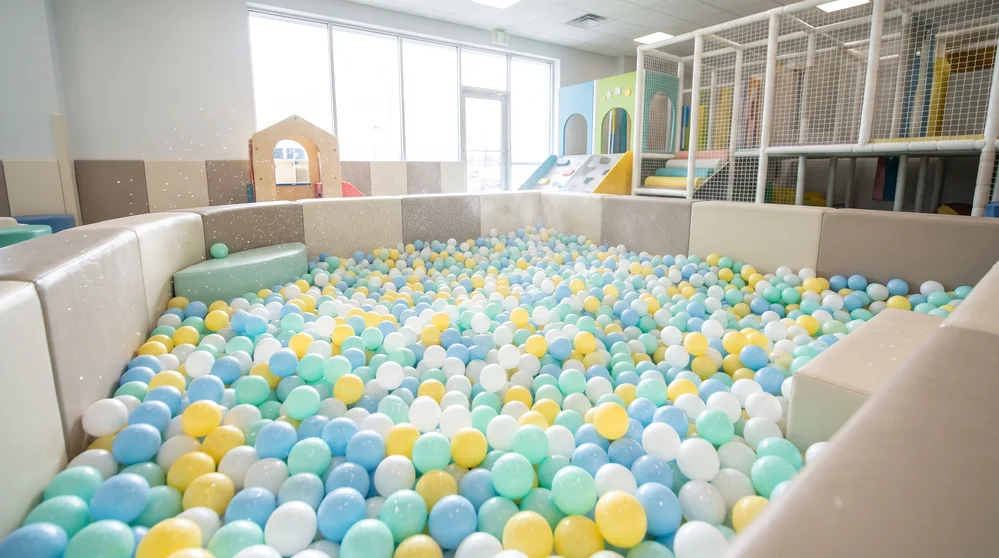
To clean a ball pit in a commercial venue, close it, take every ball out, wash the balls and disinfect them for the time the product label requires, clean the empty pit, let everything dry completely, then check the balls before they go back in. Which method you use depends mostly on how many balls you have. Your closure window also needs to cover drying and cleaning the empty pit.
The cleaning sequence follows Alberta Health Services’ guidance for public indoor ball pits. This Canadian guidance is a reference for the method; use your local health department’s requirements for your US venue. For the general cleaning routine around the pit, see the indoor playground cleaning checklist.
How to clean a ball pit by hand
Keep the pit closed throughout the work:
- Close the pit and remove all the balls. Put them in net bags.
- Wash the balls in warm soapy water, then rinse.
- Use a disinfectant labeled for the intended use and application method. If its label permits immersion, soak the balls at the specified concentration for the full contact time.
- Rinse if the label requires it, then drain and let the balls air dry fully.
- Clean and disinfect the base and sides of the pit, following any label rinse instructions, and let them dry.
- Inspect the balls for sanitation and damage before they go back.
Wash off dirt before disinfecting. Check that the product is compatible with both the balls and the pit liner. The EPA says surfaces must stay visibly wet for the entire contact time; reapply if they dry early. Start the clock once the surface is wet, and take the dilution, application method and rinse instructions from the label on your product.
After a fecal, urine or vomit accident, Alberta’s guidance calls for immediate evacuation, closure, cleaning and disinfection. Remove visible contamination before processing the balls. For vomit or diarrhea, CDC recommends a disinfectant effective against norovirus, with gloves worn during cleanup. Check the product’s directions for that organism rather than assuming the routine cleaning solution is suitable.
Pick a method by pit size
Ball counts climb fast. Euro-Matic, a ball manufacturer, estimates about 6,000 balls for a 2 m x 2 m pit and about 13,000 for 3 m x 3 m, both 0.5 m deep. Treat those as vendor estimates and use your own count.
Small pits with manageable batches
Net bags, a washing tub and a drying rack can handle a small pit if you can complete the full cycle before reopening. Count the batches your tub holds and time one from washing through drying. That gives you a more useful staffing estimate than floor area alone.
Euro-Matic also describes household washing machines and dishwashers for small batches of undamaged balls. Use those only if your ball manufacturer permits the appliance and cycle; washing alone doesn’t establish that you’ve completed the disinfection step.
Mid-size pits that exceed your closing shift
Net bags make it easier to handle batches, but every ball still needs washing, rinsing and the required disinfectant contact. Plan separate places for dirty bags and cleaned balls. If the batches won’t fit your closure window, compare the cost of additional staff or a cleaning service with the cost of a machine.
Large pits and venues with several pits
A ball pit cleaning machine becomes more useful as the number of balls grows. Euro-Matic’s Pure-matic BBW2026 brochure rates cleaning at up to 15,000 balls per hour, with standard brushes for 75–80 mm balls. Its general cleaning guide quotes up to 20,000 per hour without identifying a model. Use the specification for the machine you’re considering, and ask for a demonstration with your ball diameter.
Divide your ball count by the rated hourly throughput to estimate machine processing time. For a hypothetical 13,000-ball pit at 15,000 per hour, that’s about 52 minutes. If actual throughput were half that rate, processing would take about 1 hour 44 minutes. That second figure is a planning scenario, not a measured operating rate. Add setup, handling, pit cleaning and drying before estimating the reopening time.
Follow the machine’s operating instructions and confirm which stages it performs. A cleaning rate doesn’t establish disinfectant contact time or tell you whether the balls leave dry.
Shorten the closure with a spare set
A clean spare set lets you wash and dry the removed balls while the pit is back in use. The shutdown still includes emptying the pit, cleaning and disinfecting its base and sides, letting them dry, and refilling it. A spare set takes ball processing out of that closure window.
It costs more up front and needs enough dry, covered storage for a full set. Compare the purchase and storage costs with the revenue you’d expect to lose during the additional closure, using your own booking and attendance figures.
Plan drying space before buying cleaning equipment. Hanging net sacks need air around them, and both the balls and the empty pit must be dry before refilling.
A starting schedule
Alberta’s guidance ties frequency to maintaining good sanitation rather than a fixed interval. The weekly cycle below is an operating starting point drawn from our cleaning checklist, not a US legal requirement or a guarantee that weekly cleaning is enough. Increase frequency when use or contamination calls for it, and follow your equipment instructions and local requirements.
| Frequency | Task |
|---|---|
| Before opening | Look for food, fluids, small toys, hair clips and broken balls, and remove them. |
| During the day | Staff spot-check for contamination and damaged balls. Close the pit before maintenance. |
| Weekly starting point, more often as needed | Complete the full cleaning and disinfection cycle above. |
| After a bodily-fluid incident | Close immediately; complete incident cleanup and disinfection before reopening. |
The daily inspection side, including hidden objects and what to log, is covered in the safety inspection checklist.