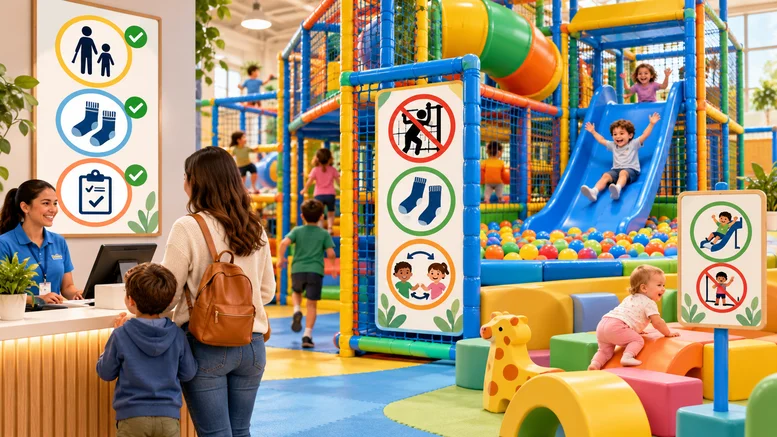
Post indoor playground rules for parents at check-in and short, illustrated rules for kids at the play structure entrance. Parents need to know who supervises, which socks to wear and what to complete before entry. Kids need instructions they can follow while playing. Put rules for a single spot, such as a toddler area or slide, beside that equipment. The template separates these three jobs.
What’s in the template
The download has two files:
- A print-ready PDF with a kids’ sign (24 × 36 in), a parents’ sign (24 × 36 in) with blanks for your ages and policies, and three zone signs (11 × 17 in) for a toddler area, a slide and a ball pit.
- An editable DOCX with the same text, so you can change the wording, add your logo and send it to a print shop.
In the PDF, the smallest rule text has capital letters about 2/3 in tall. Hang a poster with its bottom edge 37 in above the floor and every line of rule text, headings included, sits between 40 and 70 in. If you edit the DOCX or print at another size, recheck the lettering on a full-size proof; a poster’s dimensions alone don’t establish accessibility compliance.
The kids’ sign: playground rules at the structure
Hang this one at the shoe cubbies or the gate into the structure, where children pause before climbing. The PDF puts a picture beside each line for guests who can’t read yet, though a picture doesn’t replace a staff member explaining the rule to a child.
PLAY RULES
🧦 Socks on, shoes off.
🛝 Slide down feet first, one at a time.
🪜 Climb up the stairs, not the slide.
👐 Gentle hands. No pushing.
👶 Watch out for little kids.
🍎 Eat and drink at the tables.
🙋 Hurt or stuck? Tell a grown-up.
The slide instructions separate children moving in opposite directions. “Gentle hands” names a behavior staff can correct, while “Hurt or stuck?” gives children a way to ask for help. Keeping food at the tables also gives staff a clear boundary for cleaning.
The parents’ sign: conditions of entry
This sign belongs where parents pay or check in, before they complete waivers or buy socks. Adapt the wording to your venue’s policies before printing.
BEFORE YOU PLAY
- An adult age ___ or older must stay with and supervise children.
- Complete the required waivers for children and adults before play.
- ___ socks required for kids and adults. Shoes off in play areas.
- Need shoes or braces? Please talk to our staff.
- Remove helmets, necklaces and anything with cords or drawstrings.
- Empty pockets before climbing.
- Play structure: ages ___ to ___. Toddler area: ages ___ and under.
- Adults: please don’t slide with a child on your lap.
- Food and drinks stay in the ___.
- If your child is sick, talk to staff before entering.
- Tell our staff about spills, damage or injuries right away.
A few of these lines need a decision before you print them.
Supervising adult. Set the minimum supervisor age under your venue’s policy. Say where adults need to stay: permission to sit in a café on another floor means something different from staying beside the play area. The sign should match how you expect parents to supervise.
Socks. Specify grip or non-grip according to your equipment guidance and venue policy. Kids Empire, for example, requires non-grip socks for every child and adult and sells them at the front desk. If you sell socks, put the price on the sign. Parents can then see the cost before paying for admission.
The shoes line. A parent may request an exception for a child who uses shoes, braces or orthotics. Under the ADA, a business open to the public has to make reasonable modifications to its policies for people with disabilities unless the change would fundamentally alter what it offers. Line 4 gives parents a way to ask. Set a process for assessing requests and tell staff who handles them; the sign itself cannot decide which modification an individual needs.
Cords, helmets and slides. The CPSC advises keeping helmets and clothing with drawstrings, straps or cords off playground equipment because of entanglement and strangulation hazards. Its handbook also warns that sliding with a child in tandem or on an adult’s lap can cause foot or leg fractures. The handbook excludes soft contained play equipment; these are general playground precautions, not an indoor-play standard. If adults aren’t allowed in your structure, replace line 8 with that rule.
Sick children. Replace line 10 with the specific entry and return conditions in your venue’s written illness policy before printing. Use the same wording in booking information and staff instructions so families get a consistent answer.
Your insurer, your equipment manufacturer or a local health department may require specific wording on top of this.
Zone signs for rules that apply in one spot
Some rules only make sense where they’re enforced. The template includes three:
| Zone | Sign text |
|---|---|
| Toddler area | Ages ___ and under. Big kids play in the main structure. Grown-ups, stay close. |
| Slide | Feet first. One at a time. Wait until the bottom is clear. |
| Ball pit | Step in feet first. No diving or burying. Balls stay in the pit. |
Repeat the toddler age limit at the gate so staff can point to it when an older sibling follows a toddler inside. The slide sign repeats the entry instruction but adds a decision children must make at the top: wait until the bottom is clear.
Cut any rule your staff won’t enforce
Before you print, read each rule and ask two questions. Can someone on the floor see when it’s broken? Will every staff member respond the same way every time?
“Empty pockets before climbing” passes if a staff member checks at the cubbies. “Be kind to others” gives staff less to work with than “No pushing.” A blanket “No running” rule is a poor fit if running is allowed inside your structure; restrict it to the walkways or other places where you actually stop it.
A sign is only as good as the response behind it. A new employee who lets one child go down the slide head-first to avoid an awkward conversation has rewritten your sign. Train the response along with the rule. Our guide to training indoor playground staff includes a short script for explaining a rule to a frustrated parent and offering an alternative.
Print size, mounting height and finish
The 2010 ADA Standards identify rules-of-conduct signs as informational signs subject to visual-character requirements (§§216.3 and 703.5). Confirm how those requirements apply to your installation. Selected rows from Table 703.5.5 show why placement matters:
| Character baseline above the floor | Horizontal viewing distance | Minimum capital “I” height |
|---|---|---|
| 40–70 in | Under 6 ft | 5/8 in |
| 40–70 in | 10 ft | 1 1/8 in |
| Over 70–120 in | Under 15 ft | 2 in |
Viewing distance means the distance from the text to an obstruction that prevents a closer approach. In the 40–70 in band, add 1/8 in of letter height per foot beyond 6 ft.
Measure a capital “I” on a full-size proof; font point size isn’t letter height. Check every line’s mounting height, including headings above 70 in. Keep visual characters at least 40 in above the floor, use conventional lettering and contrasting text and background, and choose a non-glare finish. Size alone doesn’t cover all of §703.5, which also specifies proportions and spacing.
Ask your print shop for a matte proof, and inspect it under your venue’s lights before approving the order.
Once the signs are up, they’re part of your inspections. The weekly section of our indoor playground safety checklist already asks staff to confirm that age, height, sock, capacity and supervision signs are clean and visible. Add the zone signs to that line, and check that nobody has hung a balloon arch in front of them.