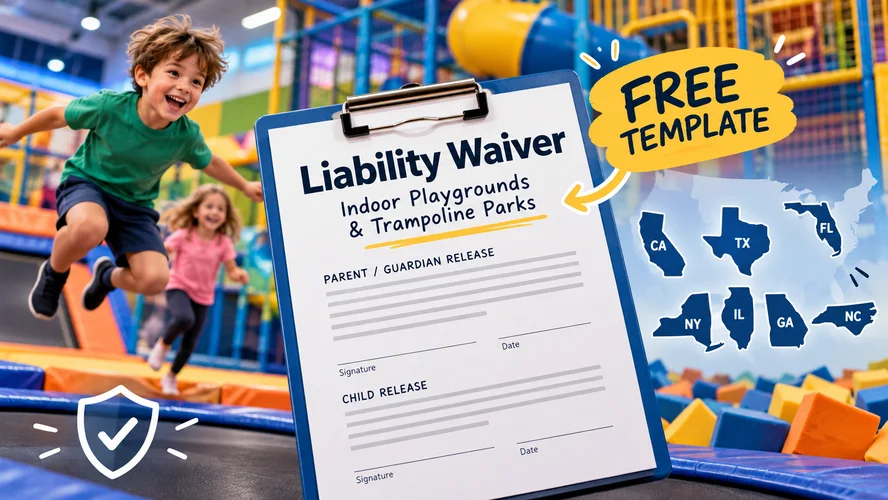
This free liability waiver template gives indoor playgrounds, play cafes and trampoline parks a starting draft with separate releases for the parent’s own claims and the child’s claims. Your state determines whether to include a child release at all. Colorado permits parent-signed releases of a child’s prospective negligence claims; Kentucky rejected one at a for-profit trampoline park. Florida permits a narrower release for inherent risks, with a mandatory statutory notice.
The form also records the risks you disclosed, the rules the parent accepted and emergency contact details. Those records remain useful even where a child release is unenforceable.
Before you copy it
Download the template as DOCX or PDF, or copy the form below into your document or waiver software. Text in [BRACKETS] is yours to fill in or delete. Identify your legal entity as well as the venue name, and have counsel determine which other parties the release can cover.
Keep the release sections prominent when you move them into your waiver software or print layout. For Florida’s notice, bold Markdown does not establish the required font size; set that in the finished form.
Treat this as a draft for a lawyer licensed in your state. The seven-state table below identifies different legal limits; it doesn’t certify either module for your venue. Counsel needs to review the adult release too, along with your attractions, insurer’s requirements and current law.
Indoor playground liability waiver template
[BUSINESS LEGAL NAME], d/b/a [VENUE NAME]
[Street address, city, state]
PARTICIPANT AGREEMENT, ASSUMPTION OF RISK AND RELEASE OF LIABILITY
Please read this entire form before signing. It affects your legal rights.
1. Who this agreement covers
Adult signing (“I”, “me”):
Full name: ______________
Date of birth: ______________
Phone: ______________
Email: ______________
Relationship to each child listed below: ______________
[Confirm that the signer has authority under the law applicable to the selected module. Florida Module B requires the child’s natural guardian.]
Children (“my child” or “my children”):
| Child’s full name | Date of birth |
|---|---|
“[VENUE NAME]” means [BUSINESS LEGAL NAME], operating as [VENUE NAME]. “Released Parties” means [BUSINESS LEGAL NAME AND OTHER PARTIES APPROVED BY COUNSEL FOR THE RELEASES USED BELOW].
2. Activities and risks
I understand that the activities at [VENUE NAME] include climbing structures, slides, ball pits, netted and padded play areas, [trampolines / foam pits / ninja course / interactive games – edit to match], party rooms and eating areas (“Activities”).
I understand that the Activities involve risks, including falls from structures and slides, collisions with other children, landing on other children or on equipment, being stepped on, getting fingers or limbs caught in netting or gaps, friction burns, choking on food or small objects brought into the play area, contact with illnesses spread between children, and injuries caused by other guests’ behavior. Injuries can include sprains, broken bones, dental injuries, concussions, permanent disability or death. [Edit the risks to match your activities. This list does not establish that each risk is legally an inherent risk.]
3. Rules and supervision
I have read the posted rules of [VENUE NAME], including [socks required, age and height zones, no food in play areas, maximum one child per slide lane – edit to match]. I will explain them to my child.
I am responsible for supervising my child at all times while on the premises. [VENUE NAME] staff monitor the play area and may remove anyone who breaks the rules, but staff do not replace parental supervision. [Edit if you offer drop-off care.]
4. Assumption of risk
I AM VOLUNTARILY ALLOWING MY CHILD TO TAKE PART IN THE ACTIVITIES AND, IF I PLAY, TAKING PART MYSELF. I ACKNOWLEDGE THE RISKS DESCRIBED IN SECTION 2. TO THE EXTENT ALLOWED BY LAW, I ACCEPT THOSE RISKS FOR MY OWN PARTICIPATION. THIS SECTION DOES NOT EXPAND THE CHILD RELEASE IN SECTION 6.
5. Release of my own claims [use only where permitted by state law]
TO THE EXTENT ALLOWED BY THE LAW OF [STATE], I RELEASE THE RELEASED PARTIES FROM MY OWN CLAIMS ARISING FROM MY OR MY CHILD’S PARTICIPATION IN THE ACTIVITIES DURING THE TERM OF THIS AGREEMENT, INCLUDING CLAIMS FOR MY OWN INJURIES AND ANY CLAIMS FOR MY CHILD’S MEDICAL EXPENSES OR LOSS OF SERVICES THAT BELONG TO ME UNDER STATE LAW. THIS INCLUDES MY OWN CLAIMS CAUSED BY THE ORDINARY NEGLIGENCE OF THE RELEASED PARTIES. THIS RELEASE DOES NOT COVER WILLFUL AND WANTON CONDUCT, GROSS NEGLIGENCE, RECKLESS CONDUCT OR INTENTIONAL HARM, AND DOES NOT RELEASE CLAIMS BELONGING TO MY CHILD.
6. Release on behalf of my child [use one module if permitted; otherwise delete this section]
Module A (starting language where a parent may release a child’s prospective negligence claims, such as Colorado; Alaska also requires checking the statutory activity definition):
TO THE EXTENT ALLOWED BY THE LAW OF [STATE], ON BEHALF OF MY CHILD, I RELEASE AND WAIVE MY CHILD’S PROSPECTIVE CLAIMS AGAINST THE RELEASED PARTIES FOR INJURY, INCLUDING DEATH, OR PROPERTY DAMAGE ARISING FROM THE ACTIVITIES LISTED IN SECTION 2 DURING THE TERM OF THIS AGREEMENT, INCLUDING CLAIMS CAUSED BY THE ORDINARY NEGLIGENCE OF THE RELEASED PARTIES. THIS RELEASE DOES NOT COVER WILLFUL AND WANTON, RECKLESS, GROSSLY NEGLIGENT OR INTENTIONAL ACTS OR OMISSIONS. I MAKE THIS DECISION VOLUNTARILY, AFTER READING THIS FORM.
Module B (Florida only; the signer must be the child’s natural guardian. The entire notice below must appear in uppercase type at least 5 points larger than, and clearly distinguishable from, the rest of the form. Fill each name placeholder with the same counsel-approved parties covered by this module):
NOTICE TO THE MINOR CHILD’S NATURAL GUARDIAN
READ THIS FORM COMPLETELY AND CAREFULLY. YOU ARE AGREEING TO LET YOUR MINOR CHILD ENGAGE IN A POTENTIALLY DANGEROUS ACTIVITY. YOU ARE AGREEING THAT, EVEN IF [NAME OF RELEASED PARTY OR PARTIES] USES REASONABLE CARE IN PROVIDING THIS ACTIVITY, THERE IS A CHANCE YOUR CHILD MAY BE SERIOUSLY INJURED OR KILLED BY PARTICIPATING IN THIS ACTIVITY BECAUSE THERE ARE CERTAIN DANGERS INHERENT IN THE ACTIVITY WHICH CANNOT BE AVOIDED OR ELIMINATED. BY SIGNING THIS FORM YOU ARE GIVING UP YOUR CHILD’S RIGHT AND YOUR RIGHT TO RECOVER FROM [NAME OF RELEASED PARTY OR PARTIES] IN A LAWSUIT FOR ANY PERSONAL INJURY, INCLUDING DEATH, TO YOUR CHILD OR ANY PROPERTY DAMAGE THAT RESULTS FROM THE RISKS THAT ARE A NATURAL PART OF THE ACTIVITY. YOU HAVE THE RIGHT TO REFUSE TO SIGN THIS FORM, AND [NAME OF RELEASED PARTY OR PARTIES] HAS THE RIGHT TO REFUSE TO LET YOUR CHILD PARTICIPATE IF YOU DO NOT SIGN THIS FORM.
AS MY CHILD’S NATURAL GUARDIAN, I WAIVE AND RELEASE IN ADVANCE MY CHILD’S CLAIMS AGAINST [PARTIES NAMED IN THE NOTICE ABOVE] FOR PERSONAL INJURY, INCLUDING DEATH, AND PROPERTY DAMAGE RESULTING FROM AN INHERENT RISK IN THE ACTIVITIES DURING THE TERM OF THIS AGREEMENT, ONLY TO THE EXTENT AUTHORIZED BY FLORIDA STATUTES §744.301(3).
In states where a parent cannot release a child’s claims, delete Section 6 entirely. See the table below the template.
7. Emergency assistance and contact details
If staff believe my child or I need emergency assistance, I ask them to call emergency services and provide responders with relevant information from this form. This section does not authorize venue staff to make medical treatment decisions.
Allergies or medical conditions staff should know about: ______________
Emergency contact (not attending today): Name: ______________
Phone: ______________
8. Photos and video [optional, not required for entry]
☐ I agree that [VENUE NAME] may use photos or video that show my child or me on its website, social media and printed materials, without payment. I can withdraw this consent by writing to [EMAIL]; the venue will stop new uses after receiving my request. [Use a separate consent form if counsel recommends one.]
9. Term and governing law
This agreement applies to visits to [VENUE NAME] during [TERM APPROVED BY COUNSEL] from the date I sign it. It is governed by the law of [STATE, where the venue operates].
10. Signature
I have read this agreement, I understand that it limits my legal rights and those of my child to the extent allowed by law, and I sign it voluntarily. ☐ I agree to sign electronically.
Signature: ______________
Printed name: ______________
Date: ______________
Form version: [v1.0, DATE]
Child-release rules in seven states
A signature line saying “for my minor child” doesn’t establish that a parent can release the child’s claims. These seven examples show why Section 6 needs its own legal review.
| State | Statute or court ruling | Starting point for Section 6 |
|---|---|---|
| Colorado | C.R.S. §13-22-107 lets a parent release a child’s prospective negligence claims, but not claims for willful and wanton, reckless or grossly negligent conduct | Module A for counsel to adapt |
| Alaska | AS §09.65.292 permits a written, parent-signed release of prospective negligence claims for covered sports or recreational activities clearly and conspicuously listed. Its activity definition excludes devices regulated under AS §05.20 | Module A only after counsel confirms your activities qualify; list each covered attraction in Section 2 |
| Florida | Fla. Stat. §744.301(3) authorizes natural guardians to release a child’s inherent-risk claims against a commercial activity provider and specified associated parties; requires the statutory notice and formatting | Module B for counsel to adapt within those limits |
| Kentucky | Supreme Court held a parent’s pre-injury waiver at a for-profit trampoline park unenforceable (Miller v. House of Boom, 2019) | Delete Section 6 for this type of venue |
| Tennessee | Court refused to enforce a parent-signed pre-injury waiver and indemnity agreement against a minor (Blackwell v. Sky High Sports, 2017) | Delete Section 6 |
| New Jersey | Public policy bars a parent from releasing a child’s tort claims arising from a commercial recreational facility (Hojnowski v. Vans Skate Park, 2006) | Delete Section 6 |
| New York | For paid recreation facilities covered by GOL §5-326, releases of the operator’s negligence are void, for adults as well as children | Delete Section 6; Section 5 cannot cover negligence either |
Other states are not on this list because their rules need checking, not because they allow the clause. In its 2019 opinion, Kentucky’s court noted that eleven of twelve jurisdictions it reviewed had rejected similar parent-signed waivers for for-profit entities. That was the court’s historical survey, not a current count of state laws.
The House of Boom waiver was a checkbox the parent ticked before buying tickets online. The court’s ruling turned on the parent’s authority to give up the child’s claim; it did not establish that the online form was otherwise enforceable. In the Tennessee case, the waiver chose California law. The court rejected that choice because the transaction lacked a material connection to California, despite the wider brand’s history and operations there. A governing-law clause cannot be assumed to override your state’s protections for children.
What the form records when a child release fails
The parent’s own claims are separate from the child’s, although an adult release also needs to be valid under state law. In the Tennessee case, the mother voluntarily dismissed her own claims after the park sought to enforce the agreement; the court refused to enforce the child release. That distinction supports keeping Section 5 apart from Section 6. The voluntary dismissal does not prove that every adult release will hold up.
The risk disclosure and rules acknowledgment record what the parent was told and what they agreed to supervise.
Emergency contact details give staff someone to call if the attending adult cannot respond.
The paperwork around the signature matters as much as the form: who signed, which version, which children, when. That workflow, from guardian verification to party guests, is covered in our guide to setting up a waiver system for your indoor playground.
Drafting details that decide whether a release counts
Where a negligence release is permitted, state whose negligence it covers and make the clause conspicuous. In Dresser Industries v. Page Petroleum (1993), the Texas Supreme Court applied express-negligence and conspicuousness requirements to advance negligence releases. It rejected provisions printed in numbered paragraphs on the back of work orders without headings or contrasting type.
Florida gives a rebuttable presumption of validity to a waiver that complies with the statutory notice requirement and releases no more than §744.301(3) allows. That section defines inherent risks as dangers integral to the activity that remain even with due care, and includes failure to warn of an inherent risk and other participants’ negligent or intentional acts. It excludes the provider and its owners, affiliates, employees and agents from the definition of a participant. Listing a hazard in Section 2 does not bring it within that definition.
When you add a ninja course or change the age zones, update the relevant activity descriptions or rules and the version line, then have returning families sign the revised form. Keep the version each person actually signed; an edited master document doesn’t show what an earlier guest saw.
Adapting the template for a trampoline park
For a trampoline park, replace the playground list in Section 2 with the attractions you actually operate, such as trampoline courts, foam pits, dodgeball and any climbing or ninja elements. Describe risks relevant to those attractions, including double-bouncing, landing on the frame or pads, collisions mid-air and injuries from flips or somersaults. In Blackwell, for example, the child alleged that another player’s double bounce contributed to his awkward landing during trampoline dodgeball.
Section 3 should reflect your posted rules. If you require one jumper per trampoline, restrict flips or reserve certain courts for small children, record those rules accurately rather than copying restrictions your staff don’t enforce.