Group Bookings and School Field Trips: A Revenue Guide for FECs
Group bookings and school field trips can turn an FEC’s quiet weekday hours into predictable revenue. The opportunity isn’t simply to sell discounted admission to more children. It’s to create a product that schools, camps, youth organizations, and parent groups can approve, buy, and repeat—with enough contribution margin to justify the labor and capacity it uses.
The best field trip program solves two problems at once. It gives organizers a safe, structured experience that fits their schedule and budget. It gives the venue committed attendance, advance food orders, controlled attraction access, and a path to future family visits.
Treat group sales as a separate revenue channel
A Tuesday morning field trip behaves differently from Saturday walk-in traffic. The buyer may need a formal quote, a purchase order (PO), a certificate of insurance, tax documentation, accessibility details, and approval from several people. The final headcount may change. Payment may arrive after the visit rather than at checkout.
That makes group sales closer to a small B2B operation than a larger version of a regular admission sale.
The upside is planning power. A confirmed group gives the operator information that walk-in traffic cannot:
- Date, arrival time, visit length, and expected attendance
- Attraction mix and rotation schedule
- Food quantities and service time
- Likely staffing requirements
- Known revenue before the doors open
- Contact information for a potential annual rebooking
Schools are only one segment. The same operating system can serve day camps and summer programs, childcare centers, church groups, scout troops, recreation departments, sports teams, homeschool cooperatives, and after-school programs. Corporate outings and large private groups use a different sales message, but much of the quoting, scheduling, catering, and follow-up infrastructure is shared.
Measure contribution per facility-hour, not attendance alone
Large headcounts can look impressive while producing weak returns. An operator should judge a group by the contribution it generates during the capacity it occupies.
Start with this calculation:
Group contribution = package revenue + add-on revenue − incremental labor − food and consumables − payment or fundraising costs − other event-specific costs
Then divide that result by the hours of constrained capacity used. Include setup and reset time if the group blocks the space before or after the advertised session.
Consider a hypothetical 120-student trip:
| Item | Calculation | Amount |
|---|---|---|
| Base package | 120 × $17 | $2,040 |
| Lunch add-on | 96 × $6 | $576 |
| Arcade upgrade | 48 × $4 | $192 |
| Total event revenue | $2,808 | |
| Incremental event labor | −$620 | |
| Food, disposables, and game cost | −$410 | |
| Other event-specific costs | −$78 | |
| Estimated contribution | $1,700 |
If the visit and reset consume four facility-hours, the group produces an estimated $425 in contribution per facility-hour. Those numbers are illustrative, not industry benchmarks; each FEC should use its own wage rates, food costs, attraction throughput, and package mix.
This calculation also exposes bad discounting. A low admission price may make sense when unused capacity would otherwise earn nothing. It stops making sense when the group displaces higher-value demand, requires heavy facilitation, or creates overtime. Set separate rates or minimums for peak dates, exclusive use, and labor-intensive attractions.
Build three packages that are easy to approve
Most organizers need a quick, defensible choice—not a custom proposal with 20 options. A three-level structure usually gives enough flexibility without slowing the sale.
1. Access package
Offer a defined block of attraction time, a reserved arrival window, and a simple per-person price. This works for camps, reward trips, and youth groups whose main goal is recreation.
Specify exactly what “unlimited” means. List excluded games, height or weight restrictions, redemption rules, required socks or equipment, and whether attractions operate continuously or in rotations.
2. Meal package
Add a tightly controlled meal: for example, one or two pizza slices, a fountain drink, and a scheduled service time. A preselected meal is easier to produce than open ordering and makes the organizer’s total cost clear.
Collect allergy and dietary information by a fixed deadline. Keep the alternative-meal process separate from the main service line so one special request doesn’t stop lunch for 100 students.
3. Educational package
Combine attraction time with a facilitated lesson, student activity, and teacher materials. This package can support a different budget conversation because the organizer can show what students will do and learn.
Real US operators demonstrate the range. Main Event’s Play Academy offers hour-long bowling, laser tag, arcade, and pizza labs, while In The Game sells guided STEAM activities alongside play and food. The point isn’t to copy either menu. It’s to make learning an actual deliverable rather than adding “STEAM” to a recreation package.
Use optional add-ons sparingly:
- Meal or snack
- Arcade credits or a timed-play card
- Premium attraction
- Facilitated lesson
- Take-home activity or souvenir
- Private room or exclusive zone
Every add-on should have an owner, a fulfillment step, and a measurable effect on per-capita revenue. Remove options that create frequent errors without meaningful sales.
Turn attractions into credible learning experiences
A standards-aligned field trip needs more than a worksheet. The activity should ask students to observe a phenomenon, manipulate a variable, record evidence, or solve a problem.
For example, students using a bowling attraction could compare how ball mass and release position affect motion. In laser tag, they could predict and test reflection angles. At mini golf, small teams could sketch a path, identify constraints, test the design, and explain why the ball stopped where it did.
NGSS organizes science learning around three dimensions: science and engineering practices, disciplinary core ideas, and crosscutting concepts. Its official resources allow educators to search performance expectations by grade and dimension. A useful program map should therefore name:
- The grade band
- The relevant state standard or NGSS performance expectation
- What students will do at the venue
- What evidence or artifact they will produce
- The activity length and group size
- What the teacher can do before and after the visit
Do not claim alignment across every grade. A focused lesson for grades 3–5 is more credible than one activity supposedly serving kindergarten through 12th grade. Ask a working teacher or curriculum specialist to review the lesson before selling it as standards-aligned.
Educational positioning may also help a school identify an appropriate funding source, but it never guarantees one. The US Department of Education notes that a Title I schoolwide program may use funds for certain field trips when the expense is consistent with federal requirements, local or state policy, and the school’s comprehensive needs assessment. That is a conditional local decision, not a blanket promise that a “STEAM” trip qualifies for Title I funding. The Department’s guidance explains those conditions.
Give educators the documentation needed to make their own funding case: lesson objectives, standards references, a timed agenda, itemized pricing, and expected student outputs.
Price around capacity, labor, and buying behavior
The right rate starts with the FEC’s economics, not a competitor’s website. (See our guide on dynamic pricing and capacity tiers for indoor playgrounds). Establish five boundaries before publishing a price:
- Sellable window. Limit the group rate to times when the venue has spare capacity. Black out holidays and high-demand periods or quote them separately.
- Minimum commitment. Use a minimum headcount, minimum event charge, or both. The goal is to cover fixed event labor and setup.
- Guaranteed attendance date. Set the point when the billable count becomes firm. Permit a small upward adjustment when capacity allows, but explain whether downward changes receive credit.
- Chaperone policy. Include the number of complimentary or student-rate adults needed to supervise the group, then price extra adults separately. Base the ratio on attraction risk, age, and the school’s rules—not an assumed national standard.
- Payment rule. State whether the booking needs a deposit, approved PO, card authorization, or full prepayment.
Public prices are useful reference points, but they vary by geography, season, attraction, and inclusions. For example, LEGOLAND California’s school program uses seasonal student pricing, a minimum group size, a defined adult ratio, and a paid education workshop. That structure is more instructive than the dollar amount: capacity and educational facilitation are priced deliberately.
Track package conversion and add-on attachment by segment. Camps may favor food and longer play; curriculum-driven elementary trips may buy facilitation; middle-school reward groups may respond to arcade credit. One universal package leaves money on the table and often creates a poor operational fit.
Make district purchasing easy
The teacher or activity coordinator may champion the trip, but purchasing and accounts payable determine whether the transaction works. Create a school sales packet that can move through the district without repeated emails.
Include:
- Legal business name, address, and W-9
- Itemized quote with validity date
- Minimum and guaranteed attendance terms
- Cancellation, rescheduling, and weather policy
- Deposit and PO policy
- Certificate of insurance contact and available coverage documents
- Accessibility and sensory information
- Attraction restrictions and supervision requirements
- Food, allergen, and outside-lunch policy
- Bus parking and arrival instructions
- Vendor onboarding contact
Do not allow a verbal “yes” to substitute for an authorized PO when a district requires one. Natomas Unified School District, for example, says district-funded purchases must be preapproved and that it need not honor oral or unsigned contracts. It also requires invoices to reference the PO. Its purchasing FAQ shows the workflow.
Payment terms differ by customer and jurisdiction. Hurst-Euless-Bedford ISD states that valid invoices are paid within 30 days, must include the district PO number, and must exclude sales tax. Its published PO terms are a good example of why an FEC should record each district’s rules rather than assume every school pays the same way.
The same caution applies to tax exemption. Federal 501(c)(3) recognition does not automatically settle state sales-tax treatment; the IRS notes that an organization may need to seek state tax exemptions separately. Collect the applicable state or local exemption certificate before invoicing, confirm which parts of the package it covers, and retain it with the booking record. Do not rely on a school name or federal determination letter alone.
Insurance requirements also vary. Some districts request only proof of coverage, while others require specific limits or additional-insured endorsements. Send the exact request to the FEC’s broker and avoid promising that a standard certificate will satisfy every district.
Design the visit from the bus backward
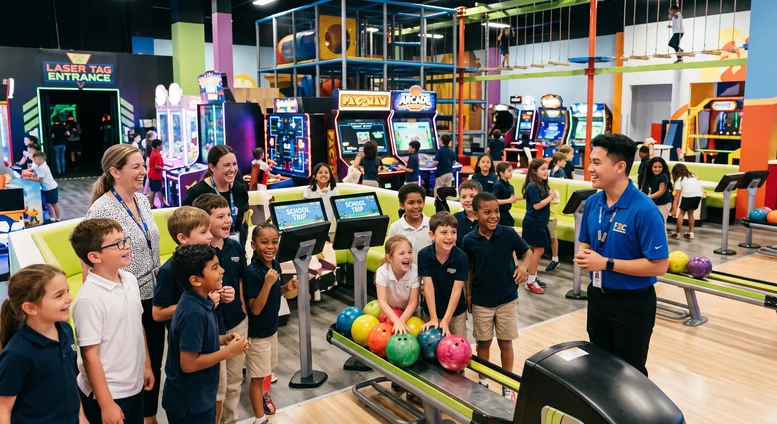
The arrival experience determines whether a 150-person booking feels organized or chaotic. Map the visit minute by minute, beginning with the bus approach and ending with departure.
A workable flow might be:
- The lead teacher texts or calls 15 minutes before arrival.
- A host meets buses at the designated unloading point.
- Students remain in assigned groups and move to a short orientation area.
- Staff confirm the final count with one organizer rather than checking in each child.
- Preassigned color groups begin staggered attraction rotations.
- Lunch is served in waves matched to kitchen capacity.
- Arcade or redemption access ends before the departure deadline.
- One staff member conducts a final sweep while groups board buses.
If waivers are legally appropriate for an attraction, distribute them before the visit and show the organizer a live completion count (as covered in our guide to indoor playground waiver setup and checklists). Have counsel review the language and process for the relevant state; a digital form is an operational tool, not a substitute for legal advice or safe operation.
Accessibility belongs in the sales and operations plan. Ask about mobility, sensory, communication, dietary, and aide needs before the event. Publish accurate information about accessible routes and attraction transfer requirements. The 2010 ADA Standards include provisions for amusement rides, load and unload areas, play areas, and accessible routes, but the guest experience also depends on staff preparation and clear alternatives when a particular attraction is unsuitable.
Run a tabletop exercise before launching the program. Test what happens when two buses arrive early, 12 waivers are missing, an attraction goes down, the lunch count is wrong, or a student needs a quieter space. A recovery plan protects both the visit and the day’s economics.
Use Spirit Nights to monetize a different weekday window
School field trips fill mornings and early afternoons. Spirit Nights can bring families into selected off-peak evenings while helping a PTA or PTO raise money.
There are two clean models:
- Revenue share: The FEC returns an agreed percentage of eligible, attributable sales.
- Wholesale resale: The parent organization buys access at a fixed rate and sells tickets at a higher price, retaining the difference.
Define attribution and exclusions in writing. State whether food, alcohol, gift cards, taxes, tips, memberships, and arcade reloads are included. Establish the minimum attendance, promotional responsibilities, settlement date, and cancellation rules.
Topgolf provides a visible example of the resale model: participating PTAs or PTOs pay a fixed per-attendee rate, choose their resale price, and keep the difference, subject to venue availability and attendance limits. Its Spirit Night program also confines events to selected days and times—an important protection for peak capacity.
Judge these events on total venue contribution after the fundraiser payment, not admission revenue alone. Food, beverages, and incremental play may make the event worthwhile, but only if labor and crowding remain controlled.
Build a repeatable sales pipeline
Group revenue becomes predictable when outreach follows the school calendar. Build a local account list by segment and record the district, school, contact role, grade range, prior visit, quote status, and preferred booking month.
Start with buyers close enough to use the venue without excessive transportation cost. Relevant contacts include principals, assistant principals, curriculum coordinators, teachers, PTO/PTA leaders, camp directors, parks and recreation staff, childcare directors, and youth program leaders.
The first message should answer practical questions immediately:
- What grade or age is the experience for?
- What does each participant receive?
- What days and times are available?
- What is the price and minimum?
- Is there an educational objective?
- How long is the visit?
- Can buses park and sack lunches be accommodated?
- How does the buyer request a quote?
Follow up after the trip while the experience is fresh. Ask the organizer about arrival, staff communication, schedule, food service, and student engagement. Then propose a rebooking window for the next school year. A repeat booking with current vendor paperwork is generally less costly to sell and easier for the school to approve than a new relationship.
Track the metrics that change decisions
A monthly group-sales dashboard should be short enough to use. Track:
- Qualified inquiries and quote-to-book rate
- Average booked headcount and revenue per attendee
- Add-on attachment by type
- Contribution per event and per facility-hour
- Lead time and cancellation rate
- Labor hours per 100 guests
- On-time start rate
- Repeat-booking rate by organization
- Accounts-receivable days for invoiced customers
- Incident, complaint, and service-recovery trends
Separate results by schools, camps, youth organizations, fundraisers, and corporate groups. Their booking cycles, acquisition costs, package preferences, and payment behavior are different. Blending them can hide a strong segment—or allow an unprofitable one to appear healthy.
A 90-day launch plan
In the first 30 days, define sellable weekday capacity, calculate package contribution, choose two or three target segments, and assemble the vendor packet. Build one recreation package and one educational pilot instead of a large menu.
During days 31–60, test the visit with an invited small group. Time every transition, measure attraction throughput, run the lunch service, and gather organizer feedback. Correct the contract, staffing model, lesson, and arrival instructions before broader outreach.
During days 61–90, contact local schools and youth organizations with a concise offer and date-specific availability. Measure responses, objections, quotes, and booked contribution. The first objective is not maximum volume. It is a product the venue can deliver consistently and buyers will book again.
Group bookings become a durable revenue channel when sales, education, finance, and floor operations work from the same plan. Package the experience clearly, protect contribution per facility-hour, remove district purchasing friction, and make the bus-to-bus visit dependable. That is what turns an empty Tuesday into revenue—and a one-time field trip into an annual account.