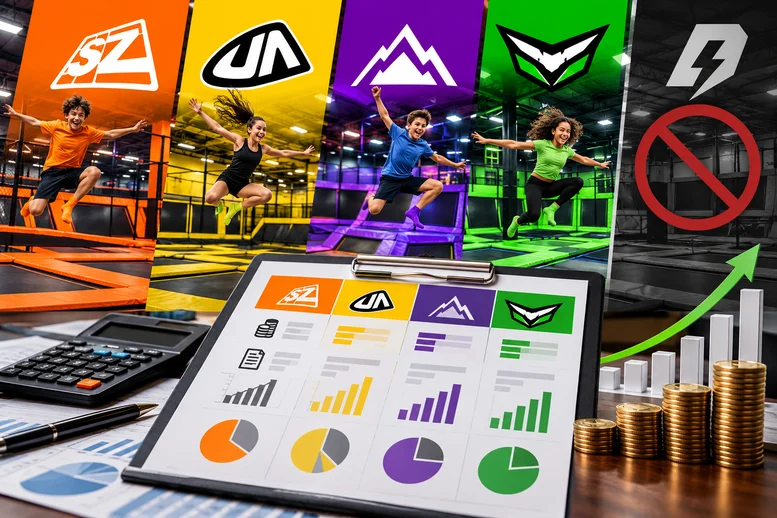
For an indoor trampoline park franchise, Altitude Trampoline Park has the lowest disclosed initial investment among these four brands, at $2.1 million to $3.5 million for a park of about 25,000 square feet. Sky Zone costs more, $3.2 million to $6.4 million depending on size, and gives you the most detailed profit data of any brand here. Urban Air suits a larger adventure-park project, starting at $2.9 million and reaching $7.9 million for its go-kart format. Launch fits if you want a family entertainment center with dining and, where permitted, a bar. DEFY, despite still showing up in comparisons, is not being franchised.
The comparison uses the Franchise Disclosure Document (FDD) versions dated below. Investment estimates come from Item 7; operating results come from Item 19 and describe 2025 reporting parks. Calculated figures are labeled separately.
Indoor trampoline park franchise costs at a glance
| Sky Zone | Altitude | Urban Air | Launch | |
|---|---|---|---|---|
| FDD used | Issued April 22, 2025, amended May 6, 2026 (Minnesota version) | April 1, 2026, amended April 7, 2026 | April 20, 2026 | May 1, 2026 |
| Park size | 16,000–50,000 sq ft | About 25,000 sq ft | 25,000–55,000 sq ft | 25,000–45,000 sq ft |
| Total initial investment (Item 7) | $3,246,160–$6,400,210 | $2,105,000–$3,477,500 | $2,852,887–$7,944,050 | $3,141,548–$6,232,089 |
| Initial franchise fee | $75,000 | $65,000 (first park) | $100,000 | $75,000 |
| Royalty + marketing at the FDD date (% of gross sales) | 6% + 3% ad fee + 4% local | 6% + 2% brand fund | 7% + 5% local | 6% + 2% brand fund + 2% local |
| 2025 gross sales, franchised parks (Item 19) | $2,255,992 average (106 parks) | $2,045,001 average (64 parks) | $3,092,533 average for 2.0 parks (81 parks, calculated from quartiles) | $2,080,000 median (14 parks) |
| Franchised parks, end of 2025 | 122 (plus 123 company-owned) | 71 (plus 10 affiliate-owned) | 202 | 28 |
Urban Air’s 2.0 average is calculated by weighting each quartile average by its park count. Launch’s figure is a median, so the sales row isn’t a like-for-like ranking.
DEFY is not on the market
DEFY parks still operate, and defy.com still has a franchise inquiry form. But DEFY’s franchisor, House of Trix, LLC, is a Sky Zone affiliate, and Sky Zone’s May 2026 amended FDD states that the company no longer offers DEFY or Rockin’ Jump franchises as of January 1, 2023. At the end of 2025 there were two franchised DEFY parks and six company-owned ones. Minnesota cancelled DEFY’s franchise registration in August 2023 after the company didn’t file its annual report.
For existing DEFY or Rockin’ Jump parks, the Sky Zone FDD describes a rebrand with no initial franchise fee and an estimated conversion cost of $234,600 to $569,600. That is a conversion budget for an existing park, not the cost of opening a new DEFY franchise.
Which franchise fits your budget and building
A 22,000-square-foot lease option falls within Sky Zone’s disclosed size range, but below the typical Altitude site and the Urban Air formats compared here. Start with the building you can obtain and the total project budget, rather than the initial franchise fee.
Altitude: a 25,000-square-foot park and the smallest check
Altitude’s FDD assumes a site of roughly 25,000 square feet. Its $2.1 million to $3.5 million estimate includes $850,000 to $1.1 million for trampolines and activity equipment, which you buy from third-party suppliers rather than from the franchisor. That’s a real difference from Sky Zone and Urban Air, where the attractions come from an affiliate.
The fee schedule is also lighter. The royalty is 6% and the brand fund is 2%. The FDD says Altitude does not currently require local advertising, and the brand fund plus local advertising can’t exceed 5% of gross sales. The technology fee is $250 a month.
Item 5 says Altitude accepted reduced initial fees of $7,500 to $40,000 per park in its last fiscal year. Its published schedule is $65,000 for the first park, $55,000 for the second and $45,000 for each additional park. The disclosure doesn’t explain the reductions or promise them to a new buyer.
Altitude grants no exclusive territory, only a protected territory if one is designated in your agreement. Its 64 reporting parks averaged $2,045,001 in 2025 gross sales. The system grew from 69 to 71 franchised parks in 2025, with five openings and three closures.
Sky Zone: trampoline-first, with the fullest profit data
Sky Zone’s investment depends on the building:
- 16,000–27,000 sq ft: $3,246,160–$4,782,210
- 27,000–39,000 sq ft: $4,189,160–$5,683,710
- 39,000–50,000 sq ft: $4,935,960–$6,400,210
Between $778,960 and $1,697,960 of that is paid to Sky Zone or its affiliates. The affiliate Sky Zone, LLC is the only approved supplier for attractions, SkySocks, wristbands and balls, and every franchisee must join Sky Zone’s Master Insurance Program. Those supplier requirements limit your ability to obtain competing quotes for a substantial part of the project.
Ongoing fees add up faster than the 6% royalty suggests. Add the 3% ad fee and the 4% local advertising requirement (after $12,000 in the first month), and 13% of gross sales is committed before rent and payroll. The disclosed technology fee is $1,480 a month.
Sky Zone provides the fullest earnings disclosure in this comparison. It reports average and median EBITDA in dollars, for 106 of its 122 franchised parks. Those parks averaged $2,255,992 in 2025 gross sales and $496,683 in EBITDA. The smallest parks, 16,000 to 22,500 square feet, averaged $1,828,750 in sales and $396,719 in EBITDA. Its “Model Parks,” with at least 25,000 square feet and four or more party rooms, averaged $2,847,069 and $710,790. In the FDD’s definition, EBITDA already deducts royalties and the ad fund, but not owner compensation or loan payments.
Item 20 shows a system that’s growing mostly through the parent company. Franchised parks went from 120 to 122 in 2025, while company-owned parks went from 114 to 123. Sky Zone also reports 70 signed franchise agreements for parks that haven’t opened yet.
Its protected territory typically covers a population of at least 150,000.
Urban Air: a larger adventure park
Urban Air still has trampolines, but it sells an adventure park with climbing, ropes courses, bumper cars, laser tag and, in its 2.5 format, go-karts. Its FDD says outright that it no longer offers its older trampoline park formats. Seven of those legacy parks were still open at the end of 2025.
The 2.0 park runs 25,000 to 40,000 square feet and costs $2,852,887 to $5,441,558, with optional attraction upgrades listed separately at $0 to $980,000. The 2.5 park needs 40,001 to 55,000 square feet and costs $4,147,074 to $7,944,050. The base attraction package for a 2.0 park alone is $1,214,760 to $1,618,650, bought from the affiliate UA Attractions.
Urban Air has the highest initial fee in this group, $100,000, and a 7% royalty. The April FDD lists the national ad fund at 0% and local marketing at 5%, for a combined 12% with the royalty. Local marketing can rise to 6% on 30 days’ notice, and Urban Air’s investment page already shows a 6% local marketing expenditure, so budget for 13%. The POS and technology fee is $2,230 a month.
The 81 reporting 2.0 parks averaged about $3.09 million in 2025, calculated from the quartile tables, and the 15 reporting 2.5 parks about $3.62 million. Urban Air’s 2026 FDD gives no cost or EBITDA figures, so you can’t tell from the document how much of that revenue survives the larger rent and equipment bill.
The pipeline is large. Urban Air ended 2025 with 202 franchised parks, opened 19, closed 10, and had 165 signed agreements for parks not yet open. Ask how many of those are in or near your territory before you sign.
Launch: if you want an FEC with a bar
The May 2026 Launch FDD covers its family entertainment center format, with multiple attractions, food service and, where permitted, a bar. The FDD estimates $3,141,548 to $6,232,089 for a 25,000- to 45,000-square-foot park. The fee is $75,000, with a 6% royalty, a 2% brand fund and local advertising at 2% in that FDD.
Launch announced a smaller-format model in July 2026. The figures here describe the May FDD; they don’t establish the investment or size requirements for that newer model.
Its earnings sample also differs from the format being compared. Only 14 of 28 franchised parks are in Item 19, and 10 of them are older “Adventure Park” formats that may have cost less to build than the FEC you’d be buying. Their median 2025 gross revenue was $2,080,000, and the 10 that reported costs averaged 22% EBITDA. Launch itself warns that those results may not be comparable to its current investment range.
What the headline numbers leave out
Urban Air’s franchise homepage advertises an average park volume of $4.6 million for a 2.0 park and $5.2 million for a 2.5 park. Its linked earnings page identifies the underlying figures as top-quartile averages of $4,684,848 and $5,266,717. In the FDD tables, those groups contain 21 and three parks respectively. They describe the highest-selling quarter of each reporting group, rather than all reporting parks.
Check how much of the system each Item 19 covers, too. Urban Air’s sales tables include 81 reporting 2.0 parks and 15 reporting 2.5 parks, or 96 of its 202 franchised parks; 70 were left out because they didn’t provide complete data. Altitude’s EBITDA percentages come from 29 of the 64 parks in its sales table. Sky Zone covers 106 of 122. Treat each average as describing its reporting group only.
Then look at the range. Altitude’s average EBITDA margin was 24.59%, but individual parks ranged from −3.76% to 44.04%. Sky Zone’s franchised parks ranged from $601,841 to $7,971,315 in sales. A mean can be pulled upward by high-selling parks. Sky Zone’s median sales were $2,140,768, below its $2,255,992 average.
What disclosed EBITDA can tell you
Sky Zone’s reporting franchisees averaged $496,683 in EBITDA. Dividing its full $3,246,160 to $6,400,210 investment range by that figure gives about 6.5 to 12.9 years. That arithmetic assumes the same earnings every year from the start and leaves out loan payments, taxes, owner compensation and equipment replacement. It doesn’t estimate your cash payback.
Altitude and Launch don’t support the same calculation. Altitude’s 24.59% average EBITDA margin comes from 29 parks, while its sales average covers 64. Launch’s 22% margin covers 10 parks, while its revenue median covers 14. Multiplying those margins by the broader sales figures would produce earnings that neither FDD actually reports. Urban Air discloses no EBITDA.
Getting the documents yourself
You don’t need to request an FDD to start reading one. Minnesota’s Department of Commerce says its CARDS registry contains public franchise registration documents. Search by the legal franchisor names: Sky Zone Franchise Group, LLC; ATP Franchising, LLC; UATP Management, LLC; and Launch Franchising, LLC.
Under the FTC Franchise Rule, you must receive the FDD at least 14 days before signing a contract or paying money to the franchisor or its affiliate. The copy you receive may include state-specific amendments.
Item 20 and its exhibits list current and former franchisees with phone numbers. Sky Zone and Altitude both disclose that some franchisees have signed confidentiality clauses, so a former owner who won’t talk may not be allowed to.